Pianists Martha Argerich and Sergei Babayan have recorded two selections from Prokofiev’s music for stage and screen in magnificent two-piano transcriptions by Babayan. Prokofiev for Two, set for release worldwide March 23 via Deutsche Grammophon/Universal Music Canada, the country’s leading music company, captures for posterity the sense of mutual inspiration felt by these kindred spirits, palpable in their live performances together. The upcoming album features Babayan’s twelve-movement transcription of numbers from the ballet Romeo and Juliet and his seven-movement suite transcribed from Prokofiev’s incidental music for Hamlet and Eugene Onegin, film score for The Queen of Spades and opera War and Peace.
Martha Argerich and Sergei Babayan first met in Brussels in 1991 when, on a whim, he looked her up in the phonebook and, to his own surprise, found her name and telephone number listed. His call from a phone box in the city started a strong friendship that led to numerous joint appearances in Europe and America. After one performance of Rachmaninov’s “Suite No.2” and other works for two pianos, Babayan told Argerich of his dream to transcribe pieces from Romeo and Juliet for their next duo date. “She was very inspired by the idea,” he recalls. “It was the greatest pleasure – and an honour – to create something that we would play together.” Babayan’s take on Prokofiev, coupled with a suite of rarities from the composer’s stage and film music, can be heard in Prokofiev for Two.
The freshly transcribed Prokofiev score received its premiere performance as part of the Martha Argerich Project at the 2013 Lugano Festival. Argerich and Babayan have since performed this work together with the revised Romeo and Juliet suite several times, most recently in concert at Stuttgart’s Liederhalle last November.
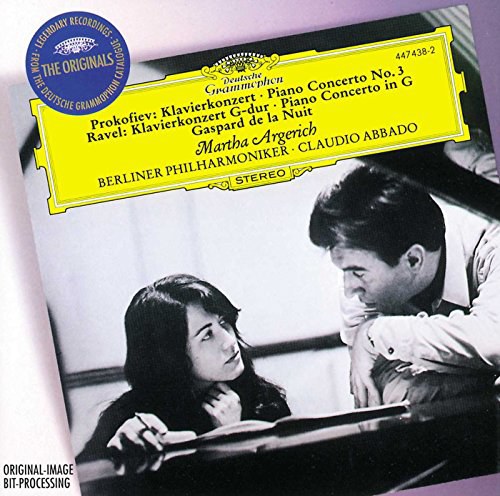
Martha Argerich is already renowned for her interpretations of Prokofiev’s music. The Argentine-born artist, hailed as one of the greatest pianists of all time, included the composer’s turbulent “Toccata” in her Deutsche Grammophon recital debut album, recorded in 1960. She reinforced her international reputation seven years later with a landmark recording for the yellow label of Prokofiev’s “Third Piano Concerto” with the Berliner Philharmoniker and Claudio Abbado. “I have loved Prokofiev ever since I can recall,” notes Argerich. “And people think he loves me too sometimes! I love the way Sergei [Babayan] plays Prokofiev and many other things. The first solo recital of his I heard was Bach’s Goldberg Variations and I was incredibly impressed by it. I very much liked his proposal that we should play his transcription of Romeo and Juliet and feel very honoured that he dedicated it to me.”
Babayan’s love for Prokofiev, like Argerich’s, is deeply rooted, dating back to his childhood in Armenia and student days at the Moscow Conservatoire. Having left the USSR for the first time in 1989, he settled in the U.S. Time and again, Babayan has paid tribute to Prokofiev, playing several of his piano concertos with Valery Gergiev including at the 2015 BBC Proms in a monumental concert with the London Symphony Orchestra featuring all five of the works.
His new Prokofiev transcriptions are both dedicated to Martha Argerich. “This project happened because of my love for Prokofiev, my love for Martha and my love for the ballet Romeo and Juliet,” reflects Babayan. The idea of transcribing Romeo and Juliet first arose decades ago while he was studying Prokofiev’s colourful instrumentation in close detail with an orchestra. Already aware of Argerich’s playing, he was further inspired after hearing a pirate recording of her 1981 Carnegie Hall performance of the “Ten Pieces Op.75” from Romeo and Juliet. “I listened and was immediately drawn to learn the cycle. But I felt that Prokofiev used chamber-like numbers for his selection of music for his transcription for solo piano. If you first became acquainted with the ballet through this piano score, you would never guess or understand the whole tragic, violent, and dark nature of the original work. Of course, the ballet contains lyrical, romantic music; music filled with humour and dance movement. But it also contains music for the “Death of Tybalt” – music of love and hate.”
Believing it would be impossible for music of such powerful emotion to be conveyed by two hands, and aware of Prokofiev’s own fondness for transcription, Babayan felt driven to exploit the full expressive force and tonal richness of two pianos. His created version contains what Martha Argerich, with a wry laugh, calls “difficult and demanding” technical and musical challenges. Both musicians, however, agree that transcription is “an act of love” and Babayan’s experience with Romeo and Juliet soon led him to explore some of the composer’s lesser-known works and create the second suite on this album. As he points out, this music will be new to most listeners. For example, only fragments of the film score for The Queen of Spades have ever been performed or recorded. He underlines its imaginative and innovative qualities, adding, “I’m sure if Prokofiev had lived longer he would have used the material for The Queen of Spades for a new movie, symphony, quartet or maybe even a piano duo. This music stayed on the shelf and it was my luck to hear it.”
Prokofiev for Two is driven by the passion and power of an ideal keyboard partnership. Martha Argerich considers playing in duo with Babayan to be “a thing of alchemy – a discovery”. For his part, Babayan says the experience of performing with Argerich is like joining a conversation with a divine being, one in which “you cannot be mundane or ordinary … Martha will somehow pull out the best from you.”