liner notes:
Dear Bill: Inre the notes and commentors and attitudes about me and my music and recordings I would like to say something. I do not, and never thought of myself as a "folk" musician or a new age musician, guitarist, or sympathyzer. I despise all "revivalists" of folk music, and I despise all "New Age" music, even though Will ackerman or some other equally obnoxious person might accuse me of being the grandfather of New age guitar, music, piano or whatever.
Also, I have never used my music or stage or anything to push some kind of politics or ideology or religion or whatever. I therefore find it disgusting that country Joe or ED is going to comment on me in print. None of these people have ever understood what I was trying to do. What I have always tried to do was very simple and there is no reason to make it complex. In all my music I have never tried to do anything except express emotions, sometimes very dark emotions, depression, hatred, etc., in a coherent, musical language.
In the current searson the only people who understand me and with whom I have anything in common are punks and alternatives and industrial and no wave and antifolk, etc. Last year there was a big spread on me in Spin magazine by Byron Coley. Spin magazine, not some damned folk music zine or new age yoga yuppie magazine. My category is alternative, period. I object to another categorization. Of course, the matter is out of my hands and I cannot prevent you from doing whatever you want to do, but I want to tell you how I --- just in case you are interested --- look and feel about these matters.
For many years I was listed in the Schwann Catalog under popular. That is a much more accurate category than folk or new age. But, the most accurate category is Alternative. If you will only take the time to read the spread on me in the 1995, SPIN ALTERNATIVE RECORD GUIDE, pp. 139, 140 and 141, and look at who is included in this book and who is not, and what it says about various people, then you will have a very clear understanding of what I have always tried to do. These people understand what I am doing more than any other group of people ever ahs. Furthermore I am socially in with punks and alternatives. Every afternoon a group of us meets at the Salem Value Village. Most of us play at the Westside station in Salem. I am actively involved with a number of these groups, and am making recordings and record deals under this heading. Recently I participated in a celebration of Jerry Garcia's death. I find it to be the most accurate and friendly category that exists. I never had anything to do with any of the San Francisco LSD rock scene, I never liked any of it both the music and the people, and despite what everybody thinks I never took LSD. I despise the sixties and its phony Weltanschauung. I have never advocated people taking drugs and I never will.
I have never advocated any political or non-political slogans such as were legion in this horrible decade, the sixties, such as "Celebrate" by itself without telling me what to celebrate," or "Tune out, drop dead and," frankly I forget the thing. Or Black is beautiful or power to the people or anything alse.
By seperate mail I am sending you an article I have written for "Pulse" on Skip James, which clearly states my attitudes towards this disgusting debacle of a decade. Also my recently recorded, Symphony Number One on Vedic Themes and Sanskrit and Pali Mantras for Tuva-singer, modified Veena and Symphony Orchestra.
I do hope that nobody will try to make me out as a child of the sixties. I was playing what I play before and after the sixties. This period had very little influence on me. I was never a hippie, and had no hippie friends.
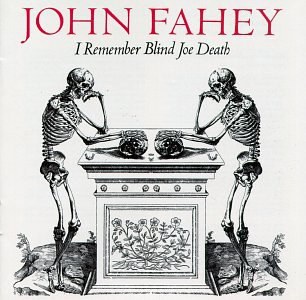
Barry Hansen has a copy of the first edition of "Blind Joe Death." I gave it to him a long time ago. Subsequent records of mine, did find me playing without finger picks, like the last 3 or 4. Why in the world don't you call me up if you want to know these things?