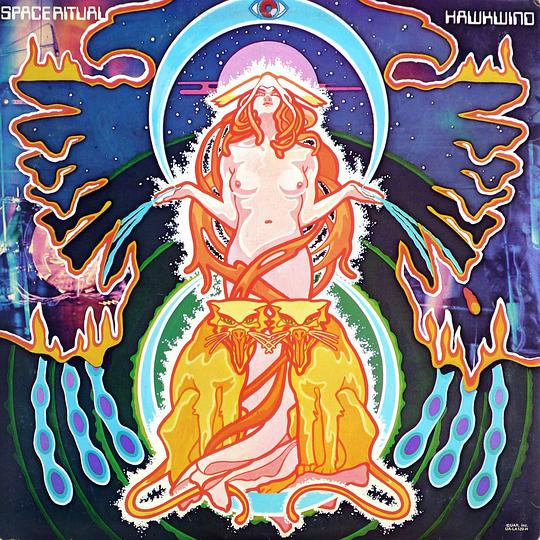
Space Ritual Douban
9.2 (20 ratings)
Hawkwind
genre:
Rock
release date 1992-09-11
publisher:
One Way Records Inc
This article covers the Hawkwind album. For the UK space rock band of the same name, see the "Space Ritual (band)" article.
The Space Ritual Alive in Liverpool and London
Live album by Hawkwind
Released May 11, 1973
Recorded December 1972
Genre Space Rock
Length 86:55 (original release)
Label United Artists – UAD60037/8
Producer Hawkwind
Hawkwind chronology
Doremi Fasol Latido
(1972) Space Ritual
(1973) Hall of the Mountain Grill
(1974)
The Space Ritual Alive in Liverpool and London is a 1973 live double album recorded in 1972 by UK rock band Hawkwind. It is their fourth album, reached #9 in the UK album charts and briefly dented the Billboard Top 200, peaking at #179.
The album was recorded during the tour to promote their Doremi Fasol Latido album, which comprises the bulk of this set. In addition, there are new tracks ("Born To Go", "Upside Down" and "Orgone Accumulator") and the songs are interspersed by electronic and spoken pieces making this one continuous performance. Curiously, their recent hit single "Silver Machine" was excluded from the set, and only "Master of the Universe" remains from their first two albums.
The Space Ritual show attempted to create a full audio-visual-cerebral experience, representing themes developed by Barney Bubbles and Robert Calvert entwining the fantasy of Starfarers in suspended animation travelling through time and space with the concept of the music of the spheres.[1] The performance featured dancers Stacia, Miss Renee and Tony Carrera, stage set by Bubbles,[2] lightshow by Liquid Len and poetry recitations by Calvert. On entering the venue, audience members were given a free programme[3] (reproduced on the 1996 remaster CD) featuring a short sci-fi story by Bubbles setting the band in a Starfarers scenario returning to Earth.
The original release featured edits and overdubs, the sleeve notes explaining that "We had to cut a piece out of Brainstorm and Time We Left because they were too long", but the 1985 Space Ritual Volume 2 album contains the full unedited versions. A previously unheard edited version of "You Shouldn't Do That" (segued with an unlisted "Seeing It As You Really Are") from this concert was included on the 1976 Roadhawks compilation album, then subsequently included as a bonus track on the 1996 remaster CD. The full unedited version of the track can be found on the Hawkwind Anthology album. June 2007 saw another EMI remaster issue with different bonus tracks and DVD-audio.
"Sonic Attack" had been written by sci-fi author Michael Moorcock, who often performed with the band when convenient and Calvert was unavailable. Here it is recited by Calvert and it was scheduled for single release, promotional copies being distributed in a cloth sleeve, but it never did receive a full release.
In the Q & Mojo Classic Special Edition Pink Floyd & The Story of Prog Rock, the album came #8 in its list of "40 Cosmic Rock Albums"
The Space Ritual Alive in Liverpool and London
Live album by Hawkwind
Released May 11, 1973
Recorded December 1972
Genre Space Rock
Length 86:55 (original release)
Label United Artists – UAD60037/8
Producer Hawkwind
Hawkwind chronology
Doremi Fasol Latido
(1972) Space Ritual
(1973) Hall of the Mountain Grill
(1974)
The Space Ritual Alive in Liverpool and London is a 1973 live double album recorded in 1972 by UK rock band Hawkwind. It is their fourth album, reached #9 in the UK album charts and briefly dented the Billboard Top 200, peaking at #179.
The album was recorded during the tour to promote their Doremi Fasol Latido album, which comprises the bulk of this set. In addition, there are new tracks ("Born To Go", "Upside Down" and "Orgone Accumulator") and the songs are interspersed by electronic and spoken pieces making this one continuous performance. Curiously, their recent hit single "Silver Machine" was excluded from the set, and only "Master of the Universe" remains from their first two albums.
The Space Ritual show attempted to create a full audio-visual-cerebral experience, representing themes developed by Barney Bubbles and Robert Calvert entwining the fantasy of Starfarers in suspended animation travelling through time and space with the concept of the music of the spheres.[1] The performance featured dancers Stacia, Miss Renee and Tony Carrera, stage set by Bubbles,[2] lightshow by Liquid Len and poetry recitations by Calvert. On entering the venue, audience members were given a free programme[3] (reproduced on the 1996 remaster CD) featuring a short sci-fi story by Bubbles setting the band in a Starfarers scenario returning to Earth.
The original release featured edits and overdubs, the sleeve notes explaining that "We had to cut a piece out of Brainstorm and Time We Left because they were too long", but the 1985 Space Ritual Volume 2 album contains the full unedited versions. A previously unheard edited version of "You Shouldn't Do That" (segued with an unlisted "Seeing It As You Really Are") from this concert was included on the 1976 Roadhawks compilation album, then subsequently included as a bonus track on the 1996 remaster CD. The full unedited version of the track can be found on the Hawkwind Anthology album. June 2007 saw another EMI remaster issue with different bonus tracks and DVD-audio.
"Sonic Attack" had been written by sci-fi author Michael Moorcock, who often performed with the band when convenient and Calvert was unavailable. Here it is recited by Calvert and it was scheduled for single release, promotional copies being distributed in a cloth sleeve, but it never did receive a full release.
In the Q & Mojo Classic Special Edition Pink Floyd & The Story of Prog Rock, the album came #8 in its list of "40 Cosmic Rock Albums"