阿甘本
Stanzas Douban
author: Giorgio Agamben / [意]吉奥乔·阿甘本 translator: Ronald L. Martinez publishing house: University of Minnesota Press 1992 - 11
Stanzas is a fascinating blend of philology, medieval physics and psychology, the psychoanalysis of toys, and contemporary linguistics and philosophy. In this unique work, Giorgio Agamben attempts to reconfigure the epistemological foundation of Western culture. He rereads Freud and Saussure to discover the impossibility of metalanguage and of synthesis that could be reflected in the transparency of signs. There is no “superior language” that can read the obscure scenes of the unconscious, and the “symbol” is always the return of the repressed in an improper signifier.
This impossibility leads Agamben to the problem of representation. He argues that because language is the locus of the production and storage of phantasms, all real objects are fractured by phantasmic itineraries that in turn divide poetry and philosophy, joy and knowledge.
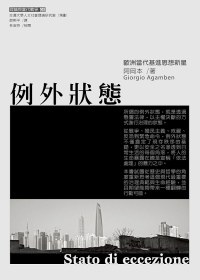
例外狀態 Douban
Stato di eccezione
9.6 (5 ratings) author: Agamben, Giorgio translator: 薛熙平 publishing house: 麥田出版社 2010 - 2
所謂的例外狀態,就是透過懸置法律(憲法),用不受法律限制的措施進行治理的狀態。這彷彿是一個無法的狀態,生命被棄置、驅逐於法律之外,即成為赤裸的生命。
傅柯將自十八世紀起,透過人口學、統計學、公共衛生、都市計畫等新興知識─權力,將人民當作生物性的人口加以計算與調節的一整套治理技術,稱之為「生命政治」。這是人類的生物性生命首度成為政治關注對象的開始。相對於傳統主權「殺生」的死亡權利,這種新的生命權力關注的是養育國家的人口素質。自此政治權力對於人的生命的作用不再僅止於死亡的威嚇,而是全面滲透到整個生命歷程之中。
根據卡爾.施密特的論點:「主權者就是決斷例外狀態之人」,主權者擁有決斷例外狀態的權力,可以隨時撤回對於裸命的政治與法律保護,公民的身分與權利隨時可被棄於無法之境。對於阿岡本而言,生命政治的現代特徵並不如傅柯所說,是將生命納入政治,而是將生命排除在政治之外。相較於傅柯式的「生物生命走入政治」的生命政治提法,阿岡本反過來問,生命如何被政治棄置,而成為赤裸的生命?從這個觀點來看,主權並不直接殺生,而是「放生」,將其逐出人類社群之外,成為裸命。這個問題意識承繼自鄂蘭對難民潮的反思:不被國家承認,喪失公民身分與法律保障的難民,正是僅以其生物上屬性而被歸屬於人類。
阿岡本所強調的是,例外狀態已非例外,而逐漸成為常態,「例外狀態已經成為規則」。現代社會誕生了一群「赤裸人」,指沒有受到政治權利與法律保護的生命狀態,這樣的生命狀態,並非只是被法律排拒在外的少數人所面臨的特殊處境,而是生活在現代國家中的所有人所面對的一般狀況。在常態化的例外狀態中,當代公民的生存模式不是自由主義設定的自主個人,而是納粹集中營裡的猶太人,或是反恐拘留營中的穆斯林,一種赤裸狀態;國家則是恐怖主義的變體,並以訴諸例外狀態來避免失序與維持秩序。
Nudities Douban
Nudities
author: Giorgio Agamben translator: Stefan Pedatella publishing house: Stanford University Press 2010 - 11
Encompassing a wide range of subjects, the ten masterful essays gathered here may at first appear unrelated to one another. In truth, Giorgio Agamben's latest book is a mosaic of his most pressing concerns. Take a step backward after reading it from cover to cover, and a world of secret affinities between the chapters slowly comes into focus. Take another step back, and it becomes another indispensable piece of the finely nuanced philosophy that Agamben has been patiently constructing over four decades of sustained research.
If nudity is unconcealment, or the absence of all veils, then Nudities is a series of apertures onto truth. A guiding thread of this collection—weaving together the prophet's work of redemption, the glorious bodies of the resurrected, the celebration of the Sabbath, and the specters that stroll the streets of Venice—is inoperativity, or the cessation of work. The term should not be understood as laziness or inertia, but rather as the paradigm of human action in the politics to come. Itself the result of inoperativity, Nudities shuttles between philosophy and poetry, philological erudition and unexpected digression, metaphysical treatise and critique of modern life. And whether the subject at hand is personal identity or the biometric apparatus, the slanderer or the land surveyor, Kafka or Kleist, every page bears the singular imprint of one of the most astute philosophers of our time.
"What Is an Apparatus?" and Other Essays Douban
author: Giorgio Agamben translator: David Kishik / Stefan Pedatella publishing house: Stanford University Press 2009 - 5
The three essays collected in this book offer a succinct introduction to Agamben's recent work through an investigation of Foucault's notion of the apparatus, a meditation on the intimate link of philosophy to friendship, and a reflection on contemporariness, or the singular relation one may have to one's own time.
"Apparatus" (dispositif in French) is at once a most ubiquitous and nebulous concept in Foucault's later thought. In a text bearing the same name ("What is a dispositif?") Deleuze managed to contribute its mystification, but Agamben's leading essay illuminates the notion: "I will call an apparatus," he writes, "literally anything that has in some way the capacity to capture, orient, determine, intercept, model, control, or secure the gestures, behaviors, opinions, or discourses of living beings." Seen from this perspective, Agamben's work, like Foucault's, may be described as the identification and investigation of apparatuses, together with incessant attempts to find new ways to dismantle them.
Though philosophy contains the notion of philos, or friend, in its very name, philosophers tend to be very skeptical about friendship. In his second essay, Agamben tries to dispel this skepticism by showing that at the heart of friendship and philosophy, but also at the core of politics, lies the same experience: the shared sensation of being.
Guided by the question, "What does it mean to be contemporary?" Agamben begins the third essay with a reading of Nietzsche's philosophy and Mandelstam's poetry, proceeding from these to an exploration of such diverse fields as fashion, neurophysiology, messianism and astrophysics.
Means Without End Douban
author: Giorgio Agamben translator: Vincenzo Binetti / Cesare Casarino publishing house: Univ Of Minnesota Press 2000 - 10
An essential reevaluation of the proper role of politics in contemporary life. A critical rethinking of the categories of politics within a new sociopolitical and historical context, this book builds on the previous work of the distinguished political philosopher Giorgio Agamben to address the status and nature of politics itself. Bringing politics face-to-face with its own failures of consciousness and consequence, Agamben frames his analysis in terms of clear contemporary relevance. He proposes, in his characteristically allusive and intriguing way, a politics of gesture-a politics of means without end.
Among the topics Agamben takes up are the "properly" political paradigms of experience, as well as those generally not viewed as political. He begins by elaborating work on biopower begun by Foucault, returning the natural life of humans to the center of the polis and considering it as the very basis for politics. He then considers subjects such as the state of exception (the temporary suspension of the juridical order); the concentration camp (a zone of indifference between public and private and, at the same time, the secret matrix of the political space in which we live); the refugee, who, breaking the bond between the human and the citizen, moves from marginal status to the center of the crisis of the modern nation-state; and the sphere of pure means or gestures (those gestures that, remaining nothing more than means, liberate themselves from any relation to ends) as the proper sphere of politics. Attentive to the urgent demands of the political moment, as well as to the bankruptcy of political discourse, Agamben's work brings politics back to life, and life back to politics.
Theory Out of Bounds Series, volume 20
Translation Inquiries: University of Minnesota Press