日本


Legend of the Galactic Heroes (2000)
銀河英雄伝説外伝:叛乱者 Douban宇宙历八世纪末、帝国历五世纪末,在卡布契兰加行星之战建立功勋的莱茵哈特·冯·缪杰尔获得基地副司令官推荐,晋升中尉成为宇宙舰队哈梅隆二号驱逐舰的航海长,好友齐格飞·吉尔菲艾斯也晋升少尉成为该舰的保安主任。出身贵族加之年纪尚轻,两位好友甫一到来招致上到副舰长下到二等兵的颇多非议和不信任。莱茵哈特和吉尔菲艾斯凭借勇猛果敢与超越阶级的平等观念赢得下级士兵的尊重。在航行至亚特密尔恒星系时,哈梅隆二号遭遇自由行星同盟舰队的伏击。身受重伤的舰长临时将指挥权交予莱茵哈特,但副舰长则强硬坚持自己的理念。少年英雄的建功之路荆棘重重……
本片根据田中芳树的经典科幻小说改编。

银河英雄传说外传:决斗者 (2000)
銀河英雄伝説外伝:決闘者 Douban刚晋升上尉的莱因哈特和吉尔菲艾斯少尉,从前线调职回奥丁的军务省。在探访安尼罗杰时得知姐姐的好友和别的贵族发生冲突,当时贵族们流行以旧式火药单发手枪决斗来解决一切纷争。莱因哈特决定为帮助姐姐的好友,出任决斗者。得知此事的培尼明迪侯爵夫人,决定乘此机会将莱因哈特杀死,暗中派出专业杀手。莱因哈特埋首不断苦练火药枪技术,不仅得到吉尔菲艾斯的协助,一名青年军官的教导及示范,使莱因哈特对火药枪的使用技巧增加了不少。这名军官便是日後的帝国元帅鲁兹少校。在决斗场上,暗杀者瞄准了莱因哈特的心脏。然而面对暗杀者的莱因哈特,在此电光石火之际竟然处於劣势,莱因哈特最终中弹……


情熱大陸 上野千鶴子篇 (2019)
Douban
actor:
上野千鹤子
今年の東京大学入学式で社会学者、上野千鶴子のスピーチが大きな話題を呼んだ。
冒頭で去年発覚した東京医科大の医学部入試での女子差別問題に言及し、
「学内にも社会にも性差別が横行しています」とズバリ発言。「男性の価値と成績のよさは一致しているのに、女性の価値と成績のよさとの間にはねじれがある。女子は子どものときから可愛いことを期待されます...だから女子は自分が成績がいいことや東大生であることを隠そうとするのです」と指摘した。
さらに、「(東京大学に入学し)頑張ったら報われるとあなたがたが思えることそのものが、あなたがたの努力の成果ではなく、環境のおかげだったことを忘れないようにしてください。あなたがたの恵まれた環境と能力とを、恵まれない人々を貶めるためにではなく、そういう人々を助けるために使ってください...ようこそ東京大学へ」と語りかけた約10分間の祝辞に「感動した」と共感の声が沸き起こる一方で、「祝辞にふさわしいのか?」と賛否両論が噴出し、Twitterで「上野千鶴子」がトレンド入りにするほど大反響を呼んだ。
日本における女性学・ジェンダー研究の第一人者としてベストセラー『おひとりさまの老後』を始め数々の話題作を送り出し、かつてのアグネス論争のように発言のたびに議論を呼ぶ"論客"として活躍を続けて来た上野。「テレビの密着取材は基本、受けて来ませんでしたので...」という彼女が今回、番組の取材を承諾してくれたのにも、何か理由があるに違いない。
番組では、スピーチへの賛否が渦巻く中、颯爽と仕事に臨む上野に密着。今もなお、現場取材で朝から晩まで走り回り、行く先々で毒あり、ユーモアあり、そして様々な問題提起を含んだトークで周囲の心をわしづかみにしていくスター学者の姿を追う。
さらに今回、話題となった祝辞やジェンダー問題について、現役東大生と語り合う特別授業が、東大生たちの手によって開催されることに。「血も涙もない理論派と言われてましたから...」という上野千鶴子が若者たちへ伝えたいメッセージとは?


Kasou Taishou (超级变变变 第 1 季) (1979)
欽ちゃん&香取慎吾の全日本仮装大賞 Season 1 part of TV Series: Kasou Taishou TMDB Douban
神戸文彦
actor:
萩本钦一
/
香取慎吾
在这部历久弥新的经典综艺节目中,参赛者巧妙地利用自己的道具,创作出独特而富有创意的短剧。

The Sensualist (1991)
井原西鶴 好色一代男 IMDb TMDB Douban
阿部行夫
actor:
今西正男
/
松岛实
…
other title:
好色一代男
/
Koushoku Ichidai Otoko
…
In the 54 years from his sexual awakening at the age of 7 until the age of 61, Yonosuke had relations with 3740 women and 725 men.
So we learn about the protagonist of Ihara Saikaku's 17th century novel The Sensualist in this animated adaptation, which is directed by erstwhile art director Yukio Abe, best known as the art director of the great Sanrio films of the 70s and early 80s, and scripted by erstwhile director Eiichi Yamamoto, best known for directing the experimental adult epic Belladonna.
Armed with those stats, Yonosuke makes Casanova look like the 30-year-old virgin. The 18th century Venetian and patron saint of latter-day Venutian artists such as Neil Strauss proclaims in his autobiography to have had relations with a mere 200 or so women during his lifetime. Yawn. But Casanova's autobiography is an engrossing and ethnographically invaluable piece of writing, and Yonosuke is a fictional character, so we'll call it even.
Better known as The Life of an Amorous Man, the novel was the first in a series of tracts that Ihara Saikaku published in the 1680s recounting the amorous escapades of the denizens of his Edo-period merchant class demimonde, who were apparently quite the libertines. I'm sure there are some juicy parallels waiting to be drawn between 17th century Japan and 18th century Venice by an enterprising student of comparative cultural studies.
Edo-period Japan was one of the most enlightened and liberal societies the world has ever known when it comes to sexual matters, with its sophisticated amalgamation of sexual openness and artistic expression. Rather than clients visiting prostitutes in dingy dives for a slam-bam-thank-you-mam exchange of fluids, Japan's geisha were government-sanctioned master artists who engaged clients in a classy, ritualized form of intellectual foreplay involving conversation, music and poetry.
The crème de la crème of geisha was the tayuu, and it's one of these creatures that is the object of the chase in this film. The Sensualist tells the story of a fumbling young man who seeks Yonosuke's assistance in getting with a renowned Edo tayuu. Flashbacks weave in and out of the narrative thread, filling us in on Yonosuke's respectable history of romantic dalliances.
The visuals of the film are exquisite, creating a sumptuous homage to the art of the Edo period. The characters are modeled after the style of Edo hanga, and are animated with great care under the supervision of the late great FX animator Mikiharu Akabori. Quite simply, the film is a feast for the eyes. Abe Yukio was first and foremost an art director, and the focus on the film is understandably on creating a sequence of beautiful images, which it does marvelously. There are few anime films as beautiful as this one out there. The film feels like a moving hanga.
Rather than gliding through a crude naturalistic approximation of Edo Japan, the characters inhabit the actual art and expressive symbols of the era. The ocean undulates like an ink painting, white lines on a black background. Naked bodies entwined in an embrace float through fields of lotuses. Shadows of long-eared rabbits hop across folding screens painted with stormy waves. Prints of Edo beauties or landscapes by the great masters pan across the screen, creating a heady and intoxicating atmosphere in which art, sex and life intermingle, rather than simply telling a story.
Although this is definitely a film for adults, and there is a good deal of nudity, a bit of rubbing, and a whole lot of bobbing, none of it is explicit. Actual shunga from the same period as this novel are far more explicit. Instead, symbols like the turtle and the camellia that were used back then to hint at sexual matters are used in a similar spirit during lovemaking scenes. The only time the film borders on funny is when they use the same strategy as 1001 Nights and Cleopatra and suddenly coyly shift from a shot of the couple embracing to a shot of abstract animation showing a suggestively shaped flame, or a clap of lightning that sends birds flying off of a tree. But for the most part, these shots of abstract animation are subtle and creative, and they feel like a modern extension of the traditional Japanese symbolic tradition.
Originally released in Japan around 1990, this 54-minute film was presumably a direct-to-video release. Gone were the days when a film like Belladonna, this film's only real analogue in anime, could be released in the theaters. It appears to have disappeared into obscurity fairly quickly, and it's hard to find almost any information about it anymore. Needless to say, it has not been re-released on DVD.
This film deserves a better fate. If ever a film qualified as a buried gem, this is it. There is quality work here. This was an ambitious project that was clearly a labor of love. Director Yukio Abe masterfully handles a complex narrative that flows between the present, the past and the abstract, making every image count. Mikiharu Akabori's character animation is subtle but nuanced, authentically reproducing the complex dress of the era and the styles of physical representation of Edo-era prints. And Eiichi Yamamoto deserves a lot of credit for penning an excellent script tangled with poetry, authentic inflection and subtle wit. Together, they did a good job of visualizing some pretty difficult material in a way that remained true to its explicit nature without teetering too much into the realm of bad taste.
More importantly, they fully utilized all the means available in animation to create a thematically and visually consistent interpretation of the spirit of the novel. They channel the actual art of that period into the modern means of animation, achieving a sense of artistic unity that could not be achieved in a live-action adaptation.
Despite being an erotic film, it's not meant to be titillating. The film has a sense of spiritual and literary depth that goes beyond mere sexual exploitation. It reminds me of the themes invoked in 1001 Nights, the first Animerama film, which was also directed by Eiichi Yamamoto: Ambition, lust, curiosity. The desire to push yourself to be the best YOU you can be, to go higher and higher, just to see if you can do it. That is one running themes that seems to occupy Eiichi Yamamoto in the three characters of Yonosuke, Belladonna and Aldin. 1001 Nights was intended as a film for adults addressing complex adult themes, not as erotica, and I find that that's the case with this one, although the erotic element is unmistakably more dominant here. The film feels like an homage not only to the art of Edo Japan but to the erotic sensibility of that era.
And lest all this make the film sound like a stuffy art film, it's clear that they don't take themselves too seriously. It's entertaining to watch the protagonist, a bumbling stand-in for every ordinary loser out there who isn't a Don Juan like Yonosuke, fumble his way into the arms of this goddess.
Alongside Belladonna, The Sensualist is one of the rare attempts to do tasteful and artistic adult fare in animation. The studio that produced this ambitious film might come as a surprise: It was Grouper Production, a short-lived studio that was co-founded in 1986 by Masami Hata, the director of many of the very same Sanrio productions on which Yukio Abe acted as the art director. Hata directed several of Grouper's productions, including the Hobberdy Dick TV series, the Super Mario Brothers: Princess Peach movie, and the Ping Pong Club TV series. As far as I know, this is the only film that Yukio Abe directed. Since then, he has returned to art directing, most recently working again under Masami Hata on the Stitch TV series produced by Madhouse.
How did this project come about? It seems so out of character with everything else done by the studio as well as the director. Was it a project he had always wanted the chance to direct? So many questions. Grouper continued operating for several years after this film was released, so at the very least, it didn't put them out of business, which is a relief. Belladonna was produced 20 years earlier. Films like this only seem to come around in 20 year increments. Hopefully that means we'll be getting a new one soon. It's understandable that most studios don't have the daring to try their hand at something a little more ambitious like this, but it's still a shame. The talent is out there to make a new adult epic. It only makes me all the more grateful for the occasional aw-the-hell-with-it moments of indulgence like The Sensualist


The End of Evangelion: Episode 25': Love is Destructive/One More Final: I Need You (1997)
新世紀エヴァンゲリオン劇場版 Air/まごころを、君に WikiData IMDb TMDB Douban Bangumi Eggplant.place Skybridge +4
Evangelion: 1.0 You Are (Not) Alone (2007)
ヱヴァンゲリヲン新劇場版:序 WikiData IMDb TMDB Douban Bangumi Eggplant.place Skybridge +4
Hideaki Anno
/
Masayuki
…
actor:
Megumi Ogata
/
Megumi Hayashibara
…
other title:
福音战士新剧场版:序
/
ヱヴァンゲリヲン新劇場版:序
…
2007 Japanese animated science fiction film
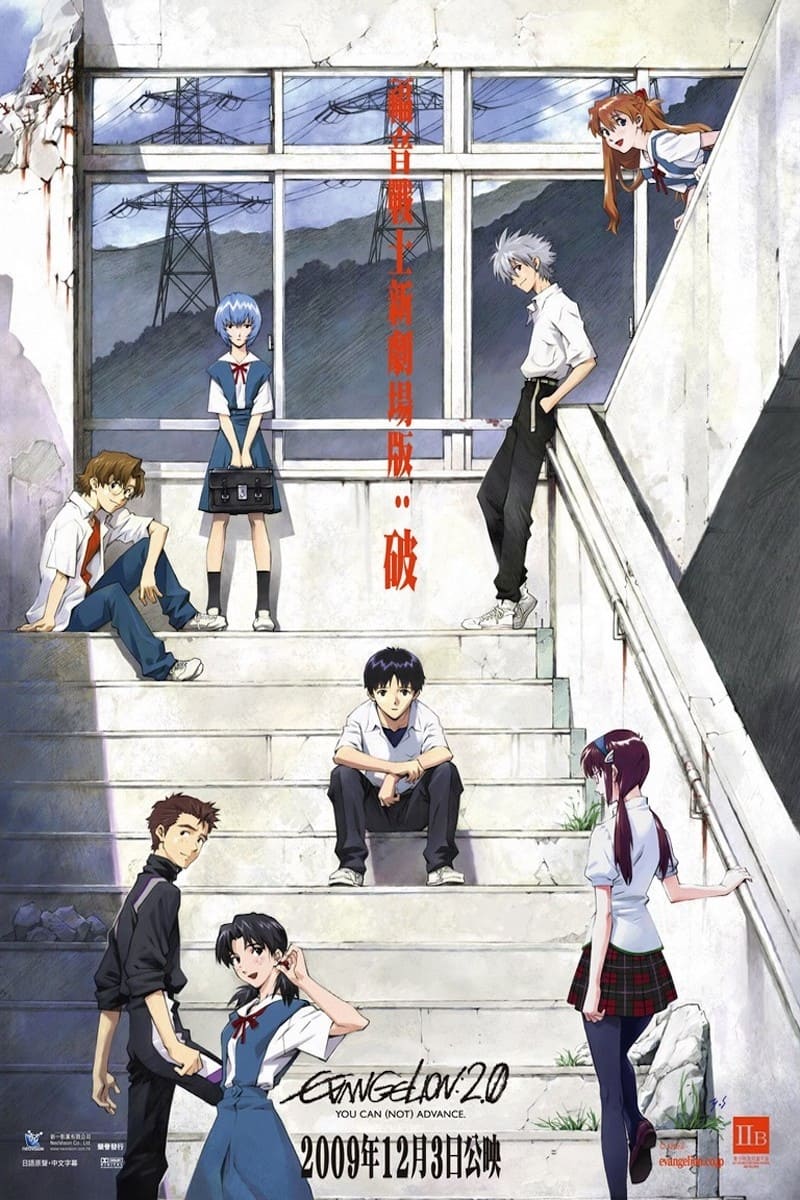
Evangelion: 2.0 You Can (Not) Advance (2009)
ヱヴァンゲリヲン新劇場版:破 WikiData IMDb TMDB Douban Bangumi Eggplant.place Skybridge +4
Hideaki Anno
/
Masayuki
…
actor:
Megumi Ogata
/
Megumi Hayashibara
…
other title:
福音战士新剧场版:破
/
ヱヴァンゲリヲン新劇場版:破
…
2009 Japanese animated film

Evangelion: 3.0 You Can (Not) Redo (2012)
ヱヴァンゲリヲン新劇場版:Q WikiData IMDb TMDB Douban Bangumi Eggplant.place Skybridge +4
Hideaki Anno
/
摩砂雪
…
actor:
Megumi Ogata
/
Akira Ishida
…
other title:
福音战士新剧场版:Q
/
ヱヴァンゲリヲン新劇場版:Q
…
2012 Japanese animated film directed by Mahiro Maeda, Kazuya Tsurumaki, Masayuki and Hideaki Anno

Hideaki Anno: The Final Challenge of Evangelion (2021)
さようなら全てのエヴァンゲリオン~庵野秀明の1214日~ IMDb TMDB Douban Eggplant.place
Aki Kubota
actor:
Hideaki Anno
other title:
再见了所有的福音战士!庵野秀明的1214日~
/
さようなら全てのエヴァンゲリオン~庵野秀明の1214日~
…
EVANGELION is coming to an end. NHK spent 4 years with exclusive access to director Hideaki Anno, documenting the creative process behind the final EVANGELION: 3.0+1.0 THRICE UPON A TIME. For the first time, the camera is allowed inside Anno's studio. The documentary attempts to capture why master filmmaker Hayao Miyazaki (STUDIO GHIBLI) describes him as one who sheds blood for his films.

