Jalal
The Pity of Partition
Douban
Ayesha Jalal
publishing house:
Princeton University Press
2013
- 2
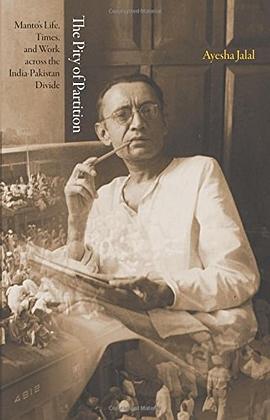
Saadat Hasan Manto (1912-1955) was an established Urdu short story writer and a rising screenwriter in Bombay at the time of India's partition in 1947, and he is perhaps best known for the short stories he wrote following his migration to Lahore in newly formed Pakistan. Today Manto is an acknowledged master of twentieth-century Urdu literature, and his fiction serves as a lens through which the tragedy of partition is brought sharply into focus. In The Pity of Partition, Manto's life and work serve as a prism to capture the human dimension of sectarian conflict in the final decades and immediate aftermath of the British raj. Ayesha Jalal draws on Manto's stories, sketches, and essays, as well as a trove of his private letters, to present an intimate history of partition and its devastating toll. Probing the creative tension between literature and history, she charts a new way of reconnecting the histories of individuals, families, and communities in the throes of cataclysmic change. Jalal brings to life the people, locales, and events that inspired Manto's fiction, which is characterized by an eye for detail, a measure of wit and irreverence, and elements of suspense and surprise. In turn, she mines these writings for fresh insights into everyday cosmopolitanism in Bombay and Lahore, the experience and causes of partition, the postcolonial transition, and the advent of the Cold War in South Asia. The first in-depth look in English at this influential literary figure, The Pity of Partition demonstrates the revelatory power of art in times of great historical rupture.
Partisans of Allah
Douban
Ayesha Jalal
publishing house:
Harvard University Press
2010
- 4
The idea of jihad is central to Islamic faith and ethics, and yet its meanings have been highly contested over time. They have ranged from the philosophical struggle to live an ethical life to the political injunction to wage war against enemies of Islam. Today, more than ever, jihad signifies the political opposition between Islam and the West. As the line drawn between Muslims and non-Muslims becomes more rigid, Ayesha Jalal seeks to retrieve the ethical meanings of this core Islamic principle in South Asian history. Drawing on historical, legal, and literary sources, Jalal traces the intellectual itinerary of jihad through several centuries and across the territory connecting the Middle East with South Asia. She reveals how key innovations in modern Islamic thought resulted from historical imperatives. The social and political scene in India before, during, and after British colonial rule forms the main backdrop. We experience the jihad as armed warfare waged by Sayyid Ahmad of Rai Bareilly between 1826 and 1831, the calls to jihad in the great rebellion of 1857, the fusion of jihad with a strand of anti-colonial nationalism in the early twentieth century, and the contemporary politics of self-styled jihadis in Pakistan, waging war to liberate co-religionists in Afghanistan and Kashmir. "Partisans of Allah" surveys this rich and tumultuous history of South Asian Muslims and its critical contribution to the intellectual development of the key concept of jihad. Analyzing the complex interplay of ethics and politics in Muslim history, the author effectively demonstrates the preeminent role of jihad in the Muslim faith today.
Self and Sovereignty
Douban
Jalal, Ayesha
2001
- 1
Self and Sovereignty surveys the role of individual Muslim men and women within India and Pakistan from 1850 through to decolonisation and the partition period. Commencing in colonial times, this book explores and interprets the historical processes through which the perception of the Muslim individual and the community of Islam has been reconfigured over time. Self and Sovereignty examines the relationship between Islam and nationalism and the individual, regional, class and cultural differences that have shaped the discourse and politics of Muslim identity. As well as fascinating discussion of political and religious movements, culture and art, this book includes analysis of: press, poetry and politics in late nineteenth-century India the politics of language and identity Hindi, Urdu and Punjabi Muslim identity, cultural difference and nationalism the Punjab and the politics of union and disunion the creation of Pakistan
Nationalism, Democracy & Development
Douban
Bose, Sugata (EDT)/ Jalal, Ayesha (EDT)
publishing house:
Oxford University Press
1997
Modern South Asia
Douban
Sugata Bose
/
Ayesha Jalal
publishing house:
Routledge
2003
A wide-ranging survey of the Indian sub-continent, Modern South Asia gives an enthralling account of South Asian history. After sketching the pre-modern history of the subcontinent, the book concentrates on the last three centuries from c.1700 to the present. Jointly written by two leading Indian and Pakistani historians, Modern South Asia offers a rare depth of understanding of the social, economic and political realities of this region.The new edition includes a rewritten, accessible introduction and a chapter by chapter revision to take into account recent research. The second edition will also bring the book completely up to date with a chapter on the period from 1991 to 2002 and a discussion of the last millennium in sub-continental history.
The State of Martial Rule
Douban
Jalal, Ayesha
2007
When the British dismantled their Raj in 1947 India, as the 'successor' state, inherited the colonial unitary central apparatus whereas Pakistan, as the 'seceding' state, had no semblance of a central government. In The State of Martial Rule Ayesha Jalal analyses the dialectic between state construction and political processes in Pakistan in the first decade of the country's independence and convincingly demonstrates how the imperatives of the international system in the 'cold war' era combined with regional and domestic factors to mould the structure of the Pakistani state. The study concludes by placing the state and political developments in Pakistan since 1958 within a conceptual framework. It will be read by historians of South Asia and by students and specialists of comparative politics and political economy.