Kierkegaard
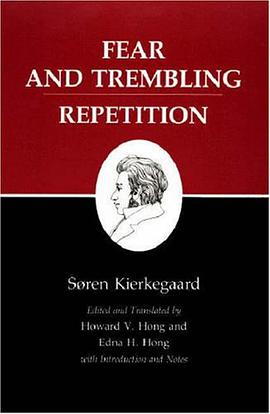
Fear and Trembling/Repetition
Douban Goodreads
★ 9.0 6 ratings
Søren Kierkegaard translator: Howard V. Hong publishing house: Princeton University Press 1983 - 6
Presented here in a new translation, with a historical introduction by the translators, Fear and Trembling and Repetition are the most poetic and personal of Soren Kierkegaard's pseudonymous writings. Published in 1843 and written under the names Johannes de Silentio and Constantine Constantius, respectively, the books demonstrate Kierkegaard's transmutation of the personal into the lyrically religious. Each work uses as a point of departure Kierkegaard's breaking of his engagement to Regine Olsen - his sacrifice of "that single individual." From this beginning Fear and Trembling becomes an exploration of the faith that transcends the ethical, as in Abraham's willingness to sacrifice his son Isaac at God's command. This faith, which persists in the face of the absurd, is rewarded finally by the return of all that the faithful one is willing to sacrifice. Repetition discusses the most profound implications of unity of personhood and of identity within change, beginning with the ironic story of a young poet who cannot fulfill the ethical claims of his engagement because of the possible consequences of his marriage. The poet finally despairs of repetition (renewal) in the ethical sphere, as does his advisor and friend Constantius in the aesthetic sphere. The book ends with Constantius' intimation of a third kind of repetition - in the religious sphere.
Read
March 23, 2011
Akedah的四个version和Problemata尤好
Kierkegaard
恐惧与颤栗
Douban
★ 8.0 6 ratings
[丹麦] 克尔凯郭尔 translator: 刘继 publishing house: 贵州人民出版社 1994 - 4
Read March 10, 2011
读英文的时候有一段一开始就是看不懂,就拿了中文本稍微参考了一下。翻译不给力啊!“造成信仰的运动”(p. 11),原文是“make the movement of faith”...我估计是从H. & E. Hong的英文译本转译的
Kierkegaard
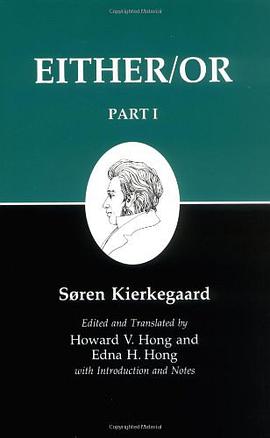
Either/Or, Part I
Douban
Søren Kierkegaard translator: Edna H. Hong publishing house: Princeton University Press 1987
Soren Kierkegaard, the nineteenth-century Danish philosopher rediscovered in the twentieth century, is a major influence in contemporary philosophy, religion, and literature. He regarded Either/Or as the beginning of his authorship, although he had published two earlier works on Hans Christian Andersen and irony. The pseudonymous volumes of Either/Or are the writings of a young man (I) and of Judge William (II). The ironical young man's papers include a collection of sardonic aphorisms; essays on Mozart, modern drama, and boredom; and "The Seducer's Diary." The seeming miscellany is a reflective presentation of aspects of the "either," the esthetic view of life. Part II is an older friend's "or," the ethical life of integrated, authentic personhood, elaborated in discussions of personal becoming and of marriage. The resolution of the "either/or" is left to the reader, for there is no Part III until the appearance of Stages on Life's Way. The poetic-reflective creations of a master stylist and imaginative impersonator, the two men write in distinctive ways appropriate to their respective positions.