
组织理论

The Sense of Dissonance
Douban
David Stark
publishing house:
Princeton University Press
2011
- 8
What counts? In work, as in other areas of life, it is not always clear what standards we are being judged by or how our worth is being determined. This can be disorienting and disconcerting. Because of this, many organizations devote considerable resources to limiting and clarifying the logics used for evaluating worth. But as David Stark argues, firms would often be better off, especially in managing change, if they allowed multiple logics of worth and did not necessarily discourage uncertainty. In fact, in many cases multiple orders of worth are unavoidable, so organizations and firms should learn to harness the benefits of such "heterarchy" rather than seeking to purge it. Stark makes this argument with ethnographic case studies of three companies attempting to cope with rapid change: a machine-tool company in late and postcommunist Hungary, a new-media startup in New York during and after the collapse of the Internet bubble, and a Wall Street investment bank whose trading room was destroyed on 9/11. In each case, the friction of competing criteria of worth promoted an organizational reflexivity that made it easier for the company to change and deal with market uncertainty. Drawing on John Dewey's notion that "perplexing situations" provide opportunities for innovative inquiry, Stark argues that the dissonance of diverse principles can lead to discovery.
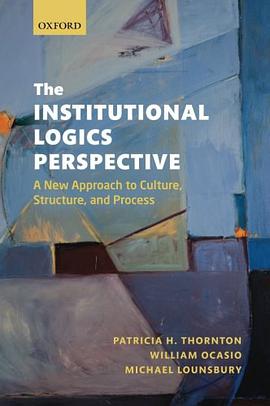
The Institutional Logics Perspective
Douban
Patricia H. Thornton
/
William Ocasio
…
publishing house:
Oxford University Press
2012
How do institutions influence and shape cognition and action in individuals and organizations, and how are they in turn shaped by them? Various social science disciplines have offered a range of theories and perspectives to provide answers to this question. Within organization studies in recent years, several scholars have developed the institutional logics perspective. An institutional logic is the set of material practices and symbolic systems including assumptions, values, and beliefs by which individuals and organizations provide meaning to their daily activity, organize time and space, and reproduce their lives and experiences. This approach affords significant insights, methodologies, and research tools, to analyze the multiple combinations of factors that may determine cognition, behaviour, and rationalities. In tracing the development of the institutional logics perspective from earlier institutional theory, the book analyzes seminal research, illustrating how and why influential works on institutional theory motivated a distinct new approach to scholarship on institutional logics. The book shows how the institutional logics perspective transforms institutional theory. It presents novel theory, further elaborates the institutional logics perspective, and forges new linkages to key literatures on practice, identity, and social and cognitive psychology. It develops the microfoundations of institutional logics and institutional entrepreneurship, proposing a set of mechanisms that go beyond meta-theory, integrating this work with macro theory on institutional logics into a cross-levels model of cultural heterogeneity. By incorporating current psychological understanding of human behaviour and linking it to sociological perspectives, it aims to provide an encompassing framework for institutional analysis, and to be an essential and accessible reference for scholars and advanced students of organizational behaviour, organization and management theory, business strategy, and cultural sociology.