György Kurtág’s music abounds in moments when things long consigned to the past waft through the corridors of time. In 6 Moments musicaux this moment occurs just before the end of …rappel des oiseaux…, where the birds of the title recall earlier eras. Almost half a century lies between these fleeting memories and the “Bird Scherzo” of his First Quartet. Back then it was specific memories of the song of blackbirds and the chirps of quarreling sparrows in a Parisian park near his place of residence.
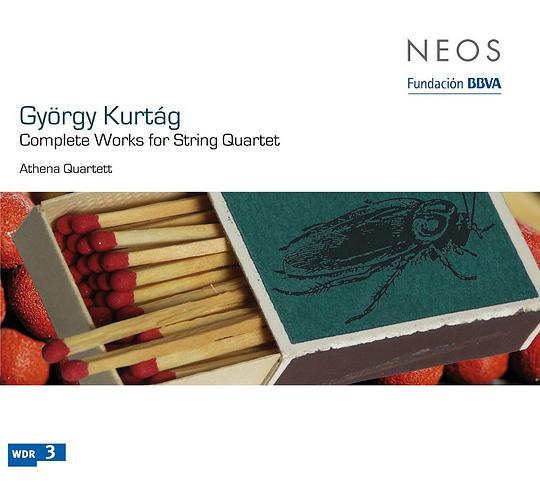
In 1957, following the suppressed Hungarian Uprising and a failed escape attempt, he moved to the banks of the Seine on a scholarship. There he spent much of his time in the Bibliotheque Nationale copying out the scores of Anton Webern. He did no composing himself. Instead he constructed insects from matchsticks. Later he would draw a multitude of long-legged cockroach-like creatures in the sketches for his First String Quartet and remember the feeling of having lived through a Kafkaesque metamorphosis himself. But before then he lost 40 pounds and even tried to give a more angular look to his handwriting.
The path leading out of this crisis finally took him to the Hungarian psychologist Marianne Stein. She advised him to begin by experimenting with no more than two or three pitches. For Kurtág, then 33 years old, it was the answer to his problems. He composed a string quartet whose first movement describes the “path of a cockroach toward the light”. He outlines the drama in a few bars with wild bowstrokes, the merest hint of a dance figure and upper partials rising toward the light.
Opus 1, marking Kurtág’s birth as a composer, consists of six brief movements which, following the model of Béla Bartók’s quartets, interlock like the layers of an onion. Traces of his study of Webern can be found in his radical reduction of the material and his use of twelve-note rows. Many elements that mark Kurtág’s music to the present day appear for the first time in this quartet: bright harmonics in the strings, uneasily throbbing heartbeats, sounds emerging from afar, birdsong, a musical flux akin to spoken language, sigh motifs of descending 2nds.
The sketches to Hommage à Mihály András similarly reveal the proximity of his music to linguistic and pre-linguistic phraseology. In the sketches for the opening movement Kurtág wrote, “sighs … sigh-screams” and, a short while later, “whispers”. He once told his fellow-composer Luigi Nono that he basically pursues two goals when composing: “To achieve a sort of unity using the resources of my chosen material, and to reach a sort of vocal composition that comes as close as possible to verbal communication”.
Rarely has he come nearer to his goal than in the fifth movement of Hommage à Mihály András. “The earthly speaks, the cosmos replies”, he later wrote about “Lontano”, one of the few compositions that he fully acknowledges (it later served as the model for the finale of …quasi una fantasia…). Hommage à Mihály András already borrows material from his earlier works.
It was here that Kurtág first made use of the piano collection Játékok (Games) that he started in 1973. Its very subtitle, 12 Mikroludien, betrays close ties to Játékok while alluding to Bartók’s Mikrokosmos. Moreover, the ascending chromatic central pitches of the twelve pieces recall Johann Sebastian Bach’s Well-Tempered Clavier. Kurtág himself calls the quartet a “micro-well-tempered series without a compulsory key scheme”.
In Officium breve the most important role models are Anton Webern and Andreae Szervánszky, to whose memory this brief liturgical celebration is dedicated like a miniature Requiem. Kurtág combines music by Anton Webern, partly in literal quotation, partly in rhapsodic paraphrase, with the C major of a string serenade by Szervánszky that breaks off unexpectedly in the final movement, “Arioso interrotto”.
The final work of the series Aus der Ferne (From afar), dedicated to his friend, the publisher Alfred Schlee, can likewise be interpreted as a “pocket Requiem”. It was written in 1999 following Schlee’s death. The cello begins “Öd und traurig” (barren and sad) by repeating, with desiccated pizzicatos, the pitch E♭, representing the first letter of Schlee’s surname in German letter notation (es or S). Sforzato outcries and two bars of fortissimo depict his sorrow at the loss of his friend.
The tranquillity that follows gives rise to a celestial ascent in F major, allowing Aus der Ferne V to fade away into silence. Kurtág frequently works with effects of distance and proximity. Many of his pieces are headed “Lontano” (distant) and “wie aus der Ferne” (as if from afar). In Hommage à Jacob Obrecht the scurrying, metal-dampened interpolations sound like musical reminiscences in fast motion.
The other-worldly sound of his most recent quartet, Arioso, is likewise the product of mechanical filtering. The two versions on our recording emerged from experiments with metallic and wooden mutes. Kurtág has declared both to be valid.
Composed in 2005, 6 Moments musicaux, with its six movements and its reminiscence of the “Birdsong Scherzo”, takes us back almost half a century to Kurtág’s Opus 1. The formal design is no longer modeled on Bartók but on Franz Schubert’s Moments musicaux. In both works only the third and fifth movements are taken at a quick tempo. These interrelated pieces also share a tribute to Johann Sebastian Bach in their fourth movement.
By using the series of pitches B-A-C-B♭ (B-A-C-H in German letter notation) Kurtág alludes to his deceased friend, the pianist György Sebök, and the admiration they shared for Bach. The final movement refers to Ludwig van Beethoven’s programmatic piano sonata Les Adieux. It also echoes, in an outcry from the violin, the “steerhorn” from Wagner’s Die Meistersinger von Nürnberg.
Further reminiscences in 6 Moments musicaux reach unusually far back into Kurtág’s own compositional history. The second movement, “footfalls”, with its faltering heartbeat, is an arrangement of a movement from his Suite for piano (1943), “the first composition I can still acknowledge”. It looks as if Kurtág’s cosmos does not have a before or an after, but only loose ends waiting to be wound up.
Martina Seeber
Translation from the German: J. Bradford Robinson