Classical
Destination Rachmaninov - Arrival Douban
Daniil Trifonov / Philadelphia Orchestra … genre: Classical
release date 2019-10-11 publisher: Deutsche Grammophon
Daniil Trifonov presents a coupling of Rachmaninov's 'Piano Concertos Nos. 1 & 3' including Trifonov's own transcriptions of Rachmaninov's famous, beloved, heart-rending 'Vocalise' and virtuosic 'The Silver Sleigh Bells'. The Grammy and Gramophone winning pianist follows in the composer's footsteps to record with the Philadelphia Orchestra, conducted by Yannick Nézet-Séguin.
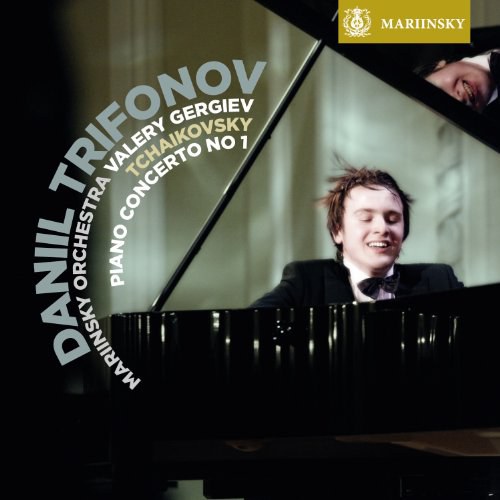
Tchaikovsky: Piano Concerto No. 1 Douban
Daniil Trifonov / Valery Gergiev … genre: Classical
release date 2012-01-01 publisher: © 2012 State Academic Mariinsky Theatre / St Petersburg …
试听:
Chopin:
-Barcarolle in F sharp major, Op. 60
Liszt:
-Erlkönig, S558 No. 4 (after Schubert D328)
-Fruhlingsglaube, S557c
-Die Forelle, S564
-Auf dem Wasser zu singen, S558 No. 2 (from Schubert D774)
-Die Stadt - Mässig Geschwindt (No. 1 from Schwanengesang, S560, after Schubert)
-Widmung S566 after Schumann (Liebeslied)
Tchaikovsky:
-Piano Concerto No. 1 in B flat minor, Op. 23 (with Mariinsky Orchestra, Valery Gergiev)
-Un poco di Chopin, Op. 72, No. 15
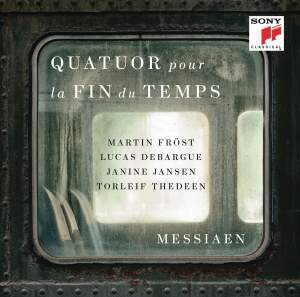
Messiaen: Quatuor pour la fin du temps Douban
Martin Fröst / Lucas Debargue … genre: Classical
release date 2017-11-03 publisher: Sony
Presenting Messiaen's most original and poignant chamber work recorded by this sensational quartet: Martin Fröst, Lucas Debargue, Janine Jansen and Torleif Thedeen. One of the most original chamber works: Olivier Messiaen is one of the great composers of the 20th century and the Quartet for the End of Time is probably his greatest chamber work. The album pushes all kinds of boundaries, first of all through its genesis in a concentration camp, through the unusual combination of the instruments, and then through the performance by Martin Fröst himself who is known for pushing musical & technical boundaries: "There is something approaching the supernatural about his command of his instrument,” said The New York Times. A very personal recording: Martin Fröst and Janine Jansen first met 16 years ago and the first piece they ever played together was the Quartet for the End of Time. Torleif Thedeen was also part of that group. This piece left them with a deep sense of connection, and now they record it together for the first time. Janine Jansen, internationally recognized as one of the great violinists and known as a “crowd pleaser", regularly receives standing ovations from enthusiastic audiences. Lucas Debargue, who became famous overnight after causing a sensation at the 2015 Tchaikovsky Competition, enjoys widespread popularity. Opportunity to promote the album through a small tour with the Quartet, starting in Barcelona and culminating in NYC at Carnegie Hall. The work was composed and first performed at a Nazi concentration camp in 1941 while Messiaen was a prisoner. It is scored for clarinet, violin, cello, and piano, reflecting the players Messiaen had available to him at this time. Messiaen, a devout Catholic, based the work on the language and imagery of the apocalypse (Book of Revelation) where time is forever abolished.
June 17, 2020 listened
大体上还算蛮鲜艳生动的,但有些时候还是太用力太直白了些,

更喜欢冷点的梅西安一些吧,
Messiaen Classical
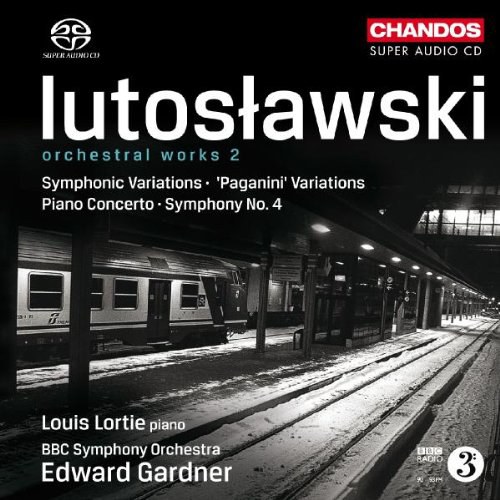
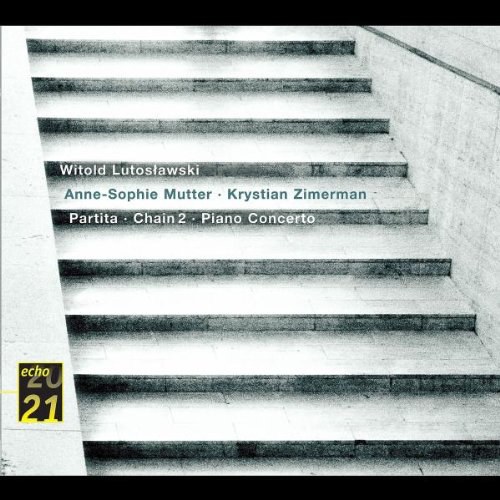
Lutoslawski: Orchestral Works Vol. 2 - Symphonic Variations, Paganini Variations, Piano Concerto, Symphony no.4 Douban
Louis Lortie / BBC Symphony Orchestra … genre: Classical
release date 2012-01-03 publisher: Chandos
This is the third volume in the Chandos series devoted to the music of the Polish composer Witold Lutosławski. It brings together his first surviving orchestral piece (The Symphonic Variations) and his last symphony, as well as two works for piano and orchestra – an early work originally written for two pianos (The ‘Paganini’ Variations), and his very last concerto. The works are performed by the BBC Symphony Orchestra under Edward Gardner, described by Gramophone as a veritable ‘Dream Team’ in Vol. 1. They are joined in this recording by Louis Lortie, the award-winning pianist and exclusive Chandos artist.
Lutosławski composed his Symphonic Variations while he was studying with Witold Maliszewski at the Warsaw Conservatory. When he showed the work to his teacher, he was told in no uncertain terms: ‘For me your work is ugly.’ A rather disheartening response to be sure, but perhaps also proof that here was a work that was well ahead of its time. Today it fits in easily with the European tradition of variation form, and is considered a prime example of the lush, but edgy harmonies of the composer, and of his vivid ear for instrumental colour and virtuosity.
Less than three years later, Poland was invaded by Germany, and normal music life disappeared. In its place, musical cafés emerged as places where light music as well as mainstream repertoire was performed. Lutosławski made his living in these cafés by playing a repertoire of light music, arranged by himself and his piano-duet partner, Andrzej Panufnik. All but one of these works were destroyed during the Warsaw Uprising in 1944. The sole survivor was the Variations on a Theme of Paganini. The version recorded here is Lutosławski’s orchestration for piano and orchestra, of the original version for two pianos.
Also on this disc is the Piano Concerto, the last of Lutosławski’s concertante works, as well as Symphony No. 4, which Lutosławski composed over four years (1988 – 92), conducting its premiere in Los Angeles, with the Los Angeles Philharmonic, in 1993, just a year before his death.
The Polish series is supported by the Adam Mickiewicz Institute.