The artistic collaboration of Shostakovich, the pre-eminent composer of the Soviet Union at the time, and the young poet Yevgeny Yevtushenko, begins with an amusing (but friendly) irony. Yevtushenko’s poem “Babi Yar” had appeared in the Literary Gazette, and Shostakovich phoned to ask the poet’s permission to set it to music. Naturally elated at the thought of his poem set by the internationally-known composer, Yevtushenko readily consented — and then Shostakovich sheepishly revealed that, in fact, he had already composed the music.
Shostakovich selected four poems of Yevtushenko’s to set for his Thirteenth Symphony; the fifth, “Fears,” the poet wrote at Shostakovich’s request, specifically for this new opus. Yevtushenko scarcely minced words in his trenchant criticism of the Workers’ Paradise. Indeed, the premiere of the Thirteenth (18 December 1962) was greeted with a thunderous applause which was little short of a political demonstration. (The year before, at the 22nd Congress of the Communist Party, Khrushchev gave a second anti-Stalin speech, and the dictator’s remains were soon removed from the mausoleum on Red Square.) Recalling impressions of that premiere, Yevtushenko wrote that “Shostakovich’s reading of my poetry was so exact in intonation and sense that it felt as if he had been inside me when I was writing the poem and he had composed the music as the lines were born.”
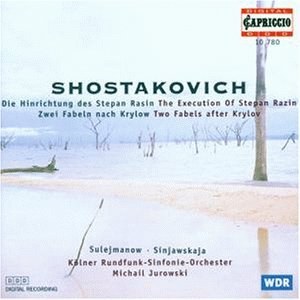
“The Execution of Stepan Razin” is an interesting follow-up, even if a bit tough to pin down. On the surface, it is compliant with the aims of ‘good Soviet poetry and music’; yet Shostakovich was a little apprehensive that the piece might run afoul of the censors (Yevtushenko had been compelled, after the premiere of the Thirteenth, to alter eight lines of “Babi Yar,” though this did not materially affect Shostakovich’s score). The tone of “Stepan Razin” borrows a certain brutality of manner from that arch-Soviet poet, Mayakovsky; and takes Gogolian satire to a macabre edge, with Razin’s severed head staring down the Tsar, and laughing in mock triumph. And the overall story, the popular folk hero Stepan Razin who stood up to the Aristocracy and the wealthy Merchants, is readily interpreted as a parable of Revolution against corrupt Government, and scorn of selfish Capitalists.
There is a dialogue between ‘Stenka’ Razin and the People, a turning point for the latter. Through the whole first part, the People are a ‘supporting cast’ for the Tsarist ‘spectacle’ of the public execution; the People revile Stenka, spit on him, and accuse him of defying them. Stenka explains his actions, apparently ‘correcting’ misconceptions on which the people of Moscow have been fed. He had imagined that, for a good Tsar, he might achieve something — “but there are no good Tsars.” And the crowd berates him in echo: “You fool, Stenka! There are no good Tsars!”
A denunciation of monarchy only (and therefore sound Socialist doctrine)? Or of all autocrats, whether monarchical or ... Communist (and therefore potentially seditious)?
At the fatal block, Stenka is collected, and defiantly calls, “Let fall the ax!” A change comes over the people, they are quiet and still, even after they are commanded to dance (a command illustrated musically, in a way recollecting the ironic phrase from Testimony, “Our business is being happy!”) As one, they remove their hats in tribute.
Decades of cloudy Western scholarship on Shostakovich have yielded scant mention of The Execution of Stepan Razin, and that begrudging attention has routinely expressed casual dismissal. The murk began decades ago as a combination of ignorance and Cold-War ideology. Today there remains something of a ‘fog of war’ as fierce partisanship takes hold of much of the musicological publication on Shostakovich. The irony of the ‘equal-but-opposite’ sources of misinformation would not have escaped Shostakovich, to whom outward circumstances were so sustainedly hostile, that by his final years he was quite embittered. Yet fairness to the composer must still be the ideal, though he himself had ceased to hope for it.
This performance reveals The Execution of Stepan Razin as a worthy successor to the Thirteenth Symphony, a piece which the West readily embraced as unambiguously dissident. And documents such as Jurowski’s excellent recording here will argue more eloquently for Razin, than any book, essay — or review.
The Two Fables after Krylov are charmingly assured settings, and a fascinating snapshot of the student composer, displaying features which largely remain intact into and through his maturity (in this, the pairing with the Opus 119 is striking). The unthinking disregard of these charming Fables (as supposedly ‘adolescent’ work), I chalk up to their being fables, and to Shostakovich’s having written the music in a way at once supportive, and interpretive, of them — disregard which betrays a bias, perhaps, of the ‘modern West,’ where many think (a little naïvely) that children’s stories are unfit for adult reflection. It is worth considering how otherwise it is in Russia, where Rimsky-Korsakov’s mature operas, and Tchaikovsky’s mature ballets, are fairy-tales; and whose national poet Pushkin wrote many elegant versified fables.
The five intermezzi from Shostakovich’s opera, The Lady Macbeth of the Mtsensk District (composed 1930-32), are engaging on more than one level. There is the ironic juxtaposition of the massive, intense passacaglia, against the other four, which are designedly light, almost trivial. And there is the wry irony that this magnum opus of Shostakovich’s, really the first work in which he built upon the compositional promise of his First Symphony (that extraordinary graduation-piece written by the 17-year-old Conservatory student), dates from before the infamous unsigned Pravda editorial which brought his star very much down to earth. Not that Shostakovich’s life before that editorial was all ease and gaiety; but compared to the trials which he endured afterwards, it must have seemed easy and merry in retrospect. These (perhaps somewhat exaggeratedly) cheerful intermezzi present one of music history’s most heart-rending imponderables. The last of them contains both pre-echoes of the Tenth Symphony (and, appropriately, Stepan Razin) and relentless percussion, ending with rather abrupt timpani-strokes ... a curiously appropriate curtain-gesture for the disc as a whole.
~Karl Henning