Paste Magazine's The 100 Best Anime Movies of All Time (2023 Update)

98 movies   2 tv shows  
Movie

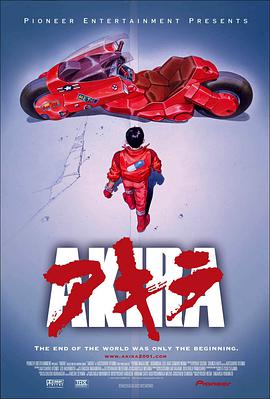
AKIRA (1988)
Akira
★ 8.3 (927 ratings) director: 大友克洋 actor: 岩田光央 / 佐佐木望 …
other title: アキラ / 亚基拉 …
A secret military project endangers Neo-Tokyo when it turns a biker gang member into a rampaging psychic psychopath that only two teenagers and a group of psychics can stop.
Anharten: The sum total of anime cinema from the early ’90s to present day is marked by the precedent of Katsuhiro Otomo’s Akira. Adapted from the early chapters of Otomo’s landmark manga series, Akira was the most expensive animated film of its time and cinematic benchmark that sent shockwaves throughout the industry. Set thirty-one years after after World War III was sparked by a massive explosion that engulfed the city of Tokyo, Akira is set in the sprawling metropolis of Neo-Tokyo, built on the ruins of the former and teetering precariously on the cusp of social upheaval. The film follows the stories of Kaneda Shotaro and Tetsuo Shima, two members of a youth motorcycle gang whose lives are irrevocably changed one fateful night on the outskirts of the city. While clashing against a rival bike gang during a turf feud, Tetsuo crashes into a strange child and is the promptly whisked away by a clandestine military outfit while Kaneda and his friends look on, helplessly. From then, Tetsuo begins to develop frightening new psychic abilities as Kaneda tries desperately to mount a rescue. Eventually the journeys of these two childhood friends will meet and clash in a spectacular series of showdowns encircling an ominous secret whose very origins rest at the dark heart of the city’s catastrophic past: a power known only as “Akira.” Like Ghost in the Shell that followed it, Akira is considered a touchstone of the cyberpunk genre, though its inspirations run much deeper than paying homage to William Gibson’s Neuromancer or Ridley Scott’s Blade Runner. Akira is a film whose origins and aesthetic are inextricably rooted in the history of post-war Japan, from the 1964 Tokyo Olympics and the “Anpo” student protests of that era to the country’s economic boom and the then-nascent counterculture of Bosozoku racing. Akira is a film of many messages, the least of which a coded anti-nuclear parable and a screed against wanton capitalism and the hubris of “progress.” But perhaps most poignantly, at its heart, it is the story of watching your best friend turn into a monster. Akira is almost singlehandedly responsible for the early 1990s boom in anime in the West, its aesthetic vision rippling across every major art form, inspiring an entire generation of artists, filmmakers and even musicians in its wake. For these reasons and so many more, every anime fan must grapple at some point or another with Akira’s primacy as the most important anime film ever made. Long Live Akira!—Toussaint Egan

Movie

Spirited Away (2001)
千と千尋の神隠し
★ 9.3 (3065 ratings) director: Hayao Miyazaki actor: Rumi Hiiragi / Miyu Irino …
other title: 千与千寻 / 千と千尋の神隠し …
A young girl, Chihiro, becomes trapped in a strange new world of spirits. When her parents undergo a mysterious transformation, she must call upon the courage she never knew she had to free her family.
Anharten: What is it about Hayao Miyazaki’s Spirited Away that makes it one of his greatest—if not the greatest—films he has ever made? Perhaps it’s because the film represents the best expression of his most defining themes and concepts to date. The strength and perseverance of a young woman, the rapturous glory of flight, the spiritual struggle of personal and cultural amnesia with Japanese society, the redeeming power of love. Or maybe it has something to do with the crux of the film’s story being so archetypically identifiable, not so much a modern reimagining as it is a spiritual evocation of Lewis Carroll’s Alice in Wonderland, a childhood odyssey in a world that feels both familiar and foreign at the same time. Whatever the case, there is nothing quite like watching Spirited Away for the first time. The image of Chihiro, having discovered her parents transformed into pigs, running frantically through the streets as the town surrounding her comes to life as lights flicker into existence and spirits rise up from the earth is nothing short of magical. Films like Nausicaä , Princess Mononoke and My Neighbor Totoro introduced the world to Hayao Miyazaki, but it was Spirited Away that secured his name among the canon of the greatest animators to have ever lived and ensured his legacy for decades to come.—Toussaint Egan

Movie

The Boy and the Heron (2023)
君たちはどう生きるか
★ 7.4 (805 ratings) director: 宫崎骏 actor: 山时聪真 / 菅田将晖 …
other title: 你想活出怎样的人生 / 君たちはどう生きるか …
2023 anime film directed by Hayao Miyazaki
Anharten: Genzaburo Yoshino’s 1937 novel How Do You Live? is a time capsule, preserving the virtues of the society it was made and circulated in. It’s about how to live as a good person in this world, about the childhood experience of discovering difference, disparity, and loss—and, thus, turning to philosophy. The influence of the text is apparent in Miyazaki’s work at Ghibli. While the protagonist of his latest film, Mahito (Soma Santoki), is styled around Miyazaki’s childhood, Miyazaki himself appears as he is today more directly in the figure of Mahito’s granduncle (Shōhei Hino), a man who built a mysterious library on the family estate decades ago before disappearing into his stories forever. The Boy and the Heron, released in Japan with the same name as Yoshino’s novel, becomes a firm reminder of the need to grow up, but one that recognizes the importance of the ephemeral experiences of childhood. Unlike Miyazaki’s semi-biographical 2013 swan song The Wind Rises, the quasi-autobiographical The Boy and the Heron is styled as the fantasy Bildungsroman that he became famous for—with a mature, edgier bent. The opening sequence depicts a 1943 firebombing, rendered with striking animation that entirely breaks with the art style of the rest of the film, veering into the abstract. Mahito’s ill mother dies in the flames. Afterwards, the 12-year-old moves to the countryside as his father Shoichi (Takuya Kimura), an industrialist contributing to the war effort, remarries his late mother’s younger sister, Natsuko (Yoshino Kimura).

Unlike the bucolic farmland of My Neighbor Totoro that imagines a space closer to nature or the remnants of a nostalgic past in Spirited Away that facilitates its fantastical traversal, the impetus for Mahito’s journey is an act of self-harm. The spirits find Mahito, feverish and delirious, on the family’s rural estate. A particularly nettlesome gray heron (Masaki Suda) harasses the boy, drawing him towards the site of his coming-of-age journey. His guide hereafter is apprehensive, the fantasies tainted with death and decay. From here, the script (trans. Don Brown) is perhaps Miyazaki’s best. Sharing its outline with all these past films, The Boy and the Heron utilizes a different narrative mode: The mythic. This is a fantasy world that deals in archetypes instead of history orientated by the polemics of fascists and philosophers. Everything is handled with delicate ambivalence, all implicit, the intentions left ambiguous. It is an open text begging to be read. Some may get the impression the film says nothing at all, but The Boy and the Heron is ultimately something more enduring than an edification. Synthesizing the virtues Yoshino wrote of a pre-war Japan with the terror of growing up in its collapsing empire, Miyazaki draws the world in its entirety. Through decades of refining his craft and iterating on this familiar story, Miyazaki has honed The Boy and the Heron into a platonic form—the kind held by Mahito’s philosopher-storyteller granduncle, who creates whole worlds with his small stone building blocks. To see The Boy and the Heron is to see Miyazaki. The film is as complicated as the man it is about, and this is what makes The Boy and the Heron a masterwork. I can see him still writing his stories, still drawing his airplanes.–Autumn Wright

Movie

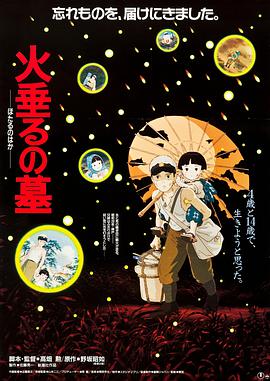
Tombstone for Fireflies (1988)
火垂るの墓
★ 8.3 (926 ratings) director: 高畑勋 actor: 辰己努 / 白石绫乃 …
other title: 萤火虫之墓 / 火垂るの墓 …
In the final months of World War II, 14-year-old Seita and his sister Setsuko are orphaned when their mother is killed during an air raid in Kobe, Japan. After a falling out with their aunt, they move into an abandoned bomb shelter. With no surviving relatives and their emergency rations depleted, Seita and Setsuko struggle to survive.
Anharten: Isao Takahata’s Grave of the Fireflies is the harrowing story of two children whose lives are left devastated by the 1945 firebombing of Kobe. Adapted from the autobiographical story of Akiyuki Nosaka, the film follows Seita, a young Japanese boy forced to care for his younger sister Setsuko in the wake of a devastating Allied attack that leaves his hometown in ruins. To describe the sum of their tragedies as “horrifying” feels like a gross understatement. The horror of Grave of the Fireflies is not reliant on brooding over callous acts of violence or fixating on the macabre, but rather on the heart-wrenching futility of Seita and Satsuko trying desperately to cling to some shred of normalcy in a world devoid of peace and security. Whether it’s the scene of Seita setting eyes on his mother for the first time after the firebombing, or Satsuko inadvertently stumbling across a corpse while playing at the beach, the film raises these children’s hopes of escaping a living hell on earth as quickly as it dashes them. The film is extraordinary in that it shows the audience, with no uncertainty, that these children will perish and somehow through its hour-and-a-half running time compels the viewer to hope that this fate can be averted. Grave of the Fireflies is a chilling portrait of the fragility of human life when confronted by the indifferent brutality of an uncaring world, a film utterly unlike anything Studio Ghibli had produced before or since. Tragic in the truest sense of the word, Grave of the Fireflies is not only one of the greatest films the studio has ever produced, but unmistakably one of the greatest anime films of all time.—Toussaint Egan

Movie

GHOST IN THE SHELL (1995)
攻殻機動隊
★ 9.1 (1366 ratings) director: 押井守 actor: 田中敦子 / 大冢明夫 …
other title: GHOST IN THE SHELL / 攻殻機動隊 / 攻殻機動隊 …
In the year 2029, the barriers of our world have been broken down by the net and by cybernetics, but this brings new vulnerability to humans in the form of brain-hacking. When a highly-wanted hacker known as 'The Puppetmaster' begins involving them in politics, Section 9, a group of cybernetically enhanced cops, are called in to investigate and stop the Puppetmaster.

Anharten: It’s difficult to overstate how enormous of an influence Ghost in the Shell exerts over not only the cultural and aesthetic evolution of Japanese animation, but over the shape of science-fiction cinema as a whole in the 21st century. Adapted from Masamune Shirow’s original 1989 manga, the film is set in the mid-21st century, a world populated by cyborgs in artificial prosthetic bodies, in the fictional Japanese metropolis of Niihama. Ghost in the Shell follows the story of Major Motoko Kusanagi, the commander of a domestic special ops task-force known as Public Security Section 9, who begins to question the nature of her own humanity surrounded by a world of artificiality. When Motoko and her team are assigned to apprehend the mysterious Puppet Master, an elusive hacker thought to be one of the most dangerous criminals on the planet, they are set chasing after a series of crimes perpetrated by the Puppet Master’s unwitting pawns before the seemingly unrelated events coalesce into a pattern that circles back to one person: the Major herself. When Ghost in the Shell first premiered in Japan, it was greeted as nothing short of a tour de force that would later go on to amass an immense cult following when it was released in the states. The film garnered the praise of directors such as James Cameron and the Wachowski siblings (whose late-century cyberpunk classic The Matrix is philosophically indebted to the trail blazed by Oshii’s precedent). Everything about Ghost in the Shell shouts polish and depth, from the ramshackle markets and claustrophobic corridors inspired by the likeness of Kowloon Walled City to the sound design, evident from Kenji Kawai’s sorrowful score to the sheer concussive punch of every bullet firing across the screen. Oshii took Shirow’s source material and arguably surpassed it, taking an already heady science-fiction action drama and transforming it into a proto-kurzweilian fable about the dawn of machine intelligence. Ghost in the Shell is more than a cornerstone of cyberpunk fiction: It’s more essential in this day and age than it was over twenty-years ago. A story about what it means to craft one’s self in the digital age, a time where the concept of truth feels as mercurial as the net is vast and infinite.—Toussaint Egan

Movie

Paprika (2006)
パプリカ
★ 9.1 (2182 ratings) director: 今敏 actor: 林原惠美 / 江守彻 …
other title: 红辣椒 / パプリカ …
2006 anime film directed by Satoshi Kon
Anharten: In a career of impeccable films, Paprika is arguably Kon’s greatest achievement. Adapted from the 1993 novel by Yasutaka Tsutsui (whose other notable novel, The Girl Who Leapt Through Time, would form the basis of Mamoru Hosoda’s 2006 film of the same name), Kon could not have asked for source material that better suited his thematic idiosyncrasies as a director. Paprika follows the story of Atsuko Chiba, a psychiatrist working on revolutionary psychotherapy treatment involving the DC Mini, a device that allows the user to record and navigate one’s dreams in a shared simulation. By day Atsuko maintains an unremittingly cold exterior, but by night she moonlights as the film’s titular protagonist: a vivacious dream detective who consults clients on her own terms. When a pair of DC Minis are stolen and loosed upon the world, causing a stream of havoc which manifests the collective unconscious into the waking world, it’s up to Paprika and her colleagues to save the day. The summation of Kon’s decade-long career as a director, Paprika is a cinematic trompe l’oeil of psychedelic colors and exquisite animation. Kon’s transition cuts are memorable and mind bending, the allusions to his immense palate of cinematic influences are savvy, and his appeal to the multiplicity of the human experience as thoughtful and poignant as ever. Unfortunately, Paprika would turn out to be Kon’s last film, as he would later tragically pass away in 2010 from pancreatic cancer. One fact remains evident when looking back on the sum total of his life’s work: Satoshi Kon was, and remains, one of the greatest anime directors of his time. He will be sorely missed.—Toussaint Egan

Movie

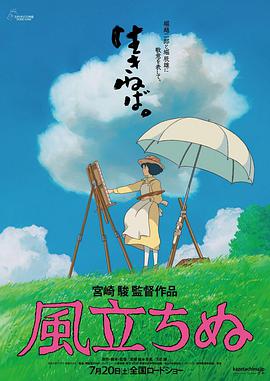
The Wind Rises (2013)
風立ちぬ
★ 7.8 (930 ratings) director: 宫崎骏 actor: 庵野秀明 / 泷本美织 …
other title: 起风了 / 風立ちぬ …
A lifelong love of flight inspires Japanese aviation engineer Jiro Horikoshi, whose storied career includes the creation of the A-6M World War II fighter plane.
Anharten: Of all of Miyazaki’s most persistent tropes and motifs, there are none more consistently threaded throughout the body of work than that of the depiction of flight. So it’s no surprise that The Wind Rises, his eleventh and final feature film to date, would focus squarely on depicting the life of Japanese aviation engineer Jiro Horikoshi and the complicated legacy his creations relate not only to the pacifist cultural identity of contemporary Japan but also, on a personal level, to Miyazaki himself. A story of how a creator cannot control what their work becomes, only the dedication and craft to which they pour into the work itself. The Wind Rises is nothing short of Miyazaki’s final artistic testament to humanity’s paradoxical capacity for both the redemptive act of creation and dogged pursuit of self-annihilation. A film that is in no uncertain terms a conclusion, if not to Miyazaki’s venerable career as one of the undisputed patriarchs of modern Japanese animation, then a thematic coda that ties together an elegant knot at the end of his venerated and storied career as a director. —Toussaint Egan

Movie

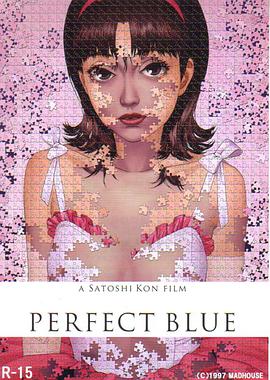
Perfect Blue (1997)
Perfect Blue
★ 9.1 (1858 ratings) director: 今敏 actor: 岩男润子 / 松本梨香 …
other title: 未麻的部屋 / 蓝色恐惧(港/台) …
Encouraged by her managers, rising pop star Mima takes on a recurring role on a popular TV show, when suddenly her handlers and collaborators begin turning up murdered.
Anharten: Perfect Blue is a precious rarity in the genre-saturation of contemporary anime: an honest-to-god psychological horror thriller brimming with malice, menace and cinematic sophistication. Adapted from Yoshikazu Takeuchi’s 1991 novel, Satoshi Kon’s feature debut follows Mima Kirigoe, a singer who retires from the pop-idol trio that gained her fame to pursue a career as an actress. As the pressures of her new career begin to take their toll, a string of vicious murders perpetrated by a mysterious assailant who claims to be an agent of the “real” Mima begins to encircle the set of her first big role. As the boundaries between her private and public life begin to blur, Mima’s grip on reality begins to fray as she stumbles spirals deeper into a tailspin of depression and madness. An avowed cinephile, the most visible influences for Kon’s work on Perfect Blue are unmistakably that of Alfred Hitchcock’s Psycho and Jonathan Demme’s The Silence of the Lambs. Dario Argento’s 1977 giallo classic Suspiria is also cited by fans and critics as a possible spiritual inspiration, though Kon himself denied having seen any of Argento’s films before hearing these comparisons. With exquisitely inventive editing, thoughtful color direction, and a gripping plot, Kon delivered a strong first outing as a director that would set the bar for his tremendous decade-spanning career. Though ostensibly a film about inherent toxicity of pop culture in manufacturing idols with same infatuation as it would destroy them, Kon was by and large unconcerned with the surface reading of his work. His interest was found beneath the folds of easy answers and trite moralizations to lay bare the truth that, as one of his characters quotes from a script, “there are no fixed truths about ourselves, only a continuous stream of memories to be ordered and rationalized.”—Toussaint Egan

Movie

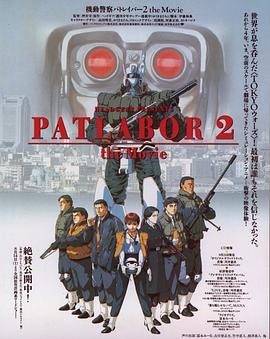
Patlabor 2 The Movie (1993)
機動警察パトレイバー 2
★ 8.9 (145 ratings) director: 押井守 actor: 富永美伊奈 / 古川登志夫 …
other title: 机动警察剧场版2 / 機動警察パトレイバー 2 …
A Japanese police unit who use giant anthropomorphic robots (called Labors) is caught up in a political struggle between the civilian authorities and the military when a terrorist act is blamed on an Air Force jet. With the aid of a government agent, the team gets close to a terrorist leader to stop things from going out of control when after the military is impelled to impose martial law.
Anharten: Patlabor 2 is Mamoru Oshii’s most formative work, an atmospheric political thriller that set the template for the aesthetic and mood that would later become his signature and distinguish the tone and substance of his most famous work, Ghost in the Shell. Set three years after the original, Patlabor 2 once again follows the Tokyo Metropolitan Police Department’s 2nd Special Vehicles unit as they are drawn into the throes of another crisis, this time concerning a rogue military commander’s plot to orchestrate a controlled state of fear and panic through which to mount a coup d’etat to overthrow the government. Where in his previous films, Oshii only flirted with political commentary that was otherwise relegated to the margins of more standard pop-action plotlines, Patlabor 2 is a full-on political thriller that’s low on giant robot showdowns and heavy on ambiance, emotion and careful pacing. It’s a work of consummate technical achievement, maturity and philosophical poignance as enduring today as it was nearly twenty-three years ago. It is the culmination of a master animator coming into the fullness of his creative faculties and the spiritual preface to the film that would later go on to become his magnum opus.—Toussaint Egan

Movie

My Neighbor Totoro (1988)
となりのトトロ
★ 9.1 (2274 ratings) director: 宫崎骏 actor: 日高范子 / 坂本千夏 …
other title: 龙猫 / となりのトトロ …
Two sisters move to the country with their father in order to be closer to their hospitalized mother, and discover the surrounding trees are inhabited by Totoros, magical spirits of the forest. When the youngest runs away from home, the older sister seeks help from the spirits to find her.
Anharten: My Neighbor Totoro is not only Miyazaki’s most iconic film to date, it’s also an all but perfect family film that manages to distill the essence of childhood whimsy down to its purest state. The film has a sort of timeless appeal about itself, disarming audiences new and old of their cynicisms and suspicions with beautiful settings, empathetic characters, and an infectious marching band theme. Set in 1958, the film follows university professor Tatsuo Kusakabe and his daughters Satsuki and Mei as they move into an old house along the countryside in order to be closer to their mother, who is recovering from a long illness. We see the world through the girls’ eyes: leaping through the fields along the house, chasing skittering dust mites, and tumbling down holes in the base of trees to land safely on the bulbous stomach of a benevolent spirit animal. My Neighbor Totoro was revolutionary for its time for luxuriating on quiet contemplative moments in a time when most of anime was otherwise dominated by the chase from one flash to the next spectacle. The late film critic Roger Ebert described it best, “My Neighbor Totoro is based on experience, situation and exploration—not on conflict and threat.” It’s a film sprung fully formed from the imagination of a master animator, a movie about the everyday magic of being a child and the simple power of meeting the world with an open heart.—Toussaint Egan

Movie

Labyrinth Tales (1987)
迷宮物語
★ 8.0 (120 ratings) director: 川尻善昭 / 林重行 … actor: 吉田日出子 / 津嘉山正种 …
other title: 迷宫物语 / 迷宮物語 …
1987 film
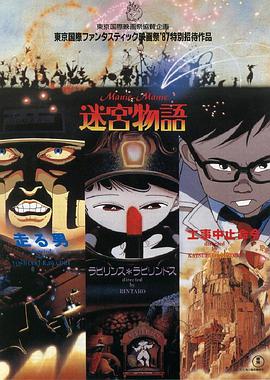
Anharten: Released in 1987 under the original title of Manie-Manie: Labyrinth Tales, Neo-Tokyo is anthology omnibus featuring shorts directed by three of the most prolific anime directors of the late-’80s: Rintaro, Yoshiaki Kawajiri, and of course, Katsuhiro Otomo. The collection was later renamed by Streamline Pictures upon its re-release in 1989 to suggest a non-existent tie-in to Otomo’s critically acclaimed Akira, which had seen a limited North American release that year. Rintaro’s “Labyrinth Labyrinthos” draws inspiration from German Expressionism and the works of Salvador Dali, depicting the story of a mischievous young girl named Sachi as she and her pet cat Cicerone are drawn into a dark dimension of hallucinatory oddities through the looking glass of her mother’s dresser. Yoshiaki Kawajiri’s “The Running Man” is a grim sci-fi noir short inspired by Blade Runner told from the perspective of a sports reporter who witnesses the final race of Zach Hugh, the fabled star of a deadly racing tournament who slowly develops deadly psionic abilities. The final short, “Construction Cancellation Order,” is arguably the anthology’s best and most accessible entry. Directed by Otomo, the short follows Tsutomu Sugioka, a Japanese salaryman dispatched by his superiors to the remote (and fictitious) South American country of the Aloana Republic to shut down their remote construction designated Facility 444. Labelled by both fans and critics alike as anime’s equivalent to Francis Ford Coppola’s Apocalypse Now, the short is indicative of Otomo’s social satire period, which would later produce Roujin-Z, taking pointed aim at the bureaucratic absurdity of Japanese working society. Though for the most part absent of any real thematic connectivity, Neo-Tokyo is a concise and powerful example of the dizzying heights of technical mastery and aesthetic ambition anime can achieve when put in the hands of the medium’s most inimitable creators.—Toussaint Egan

Movie

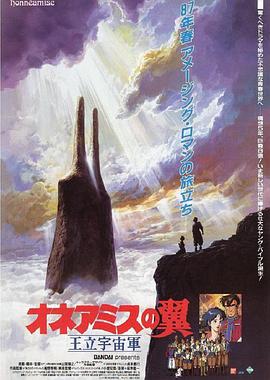
Royal Space Force: Wings of Honneamise (1987)
王立宇宙軍 オネアミスの翼
★ 8.5 (100 ratings) director: 山贺博之 actor: 森本玲夫 / 井上弥生 …
other title: 王立宇宙軍 オネアミスの翼 / 왕립우주군: 오네아미스의 날개 …
On a future Earth, war between the Kingdom of Honneamise and its rival, The Republic, is inevitable. As evolving technology creates new ways to wage war, a small group seeks to propel mankind into space in their world’s first spaceflight program. For astronaut candidate Shirotsugh Lhadatt, it’s a personal odyssey as he grows from an aimless young man into a leader willing to put everything on the line in order to move the human race forward and away from the brink of Armageddon.
Anharten: In 1987, an upstart Japanese studio called Gainax pitched Bandai Visual on the idea of a very expensive animated film about an alternate reality in which two nation states, torn by war, struggle to be first to develop manned space flight in an industrialized society. Bandai Visual, who was looking to break into the film market, liked the idea, and thus Royal Space Force: The Wings of Honnêamise was put into production, for the (at the time) massive price tag of 8M yen. The result is essentially a two-hour art film, a rumination on man’s capacity for greatness and evil that would end up as one of the most visually detailed animated films ever made … and a flop at the box office. The story concerns a young man, Shirotsugh Lhadatt, who joins the much derided “Space Force” of his nation state, Honnêamise, which is locked in perpetual war with a rival nation, The Republic. We witness Shirotsugh’s growth as a person and his journey to become an astronaut as well as his budding relationship with Riquinni Nonderaiko, a young woman whose excitement about what the space program symbolizes ignites Shirotsugh’s own passion. Perhaps one reason why The Wings of Honnêamise is rarely spoken of as a masterpiece these days is the widespread critical rejection of one particular scene, which (rightfully) has sharply divided audiences over the years. In this scene, Shirotsugh makes his way to Riquinni’s house and comes close to raping her before realizing the horrible thing he is about to do, and stopping himself. He apologizes to Riquinni, who essentially tells him it was her fault for leading him on. The reasons for, and meaning behind, the attempted rape scene and what it’s supposed to say about Shirotsugh are sound, but the reaction of Riquinni makes no sense in context of the story, and very much smacks of ’80s Japanese cultural misogyny. Obviously, watching these scenes with today’s sensitivities in place will make them seem even more pointlessly barbaric. Even so, regardless of how one feels about this particular scene, the rest of the film is well worth critical evaluation. If The Wings of Honnêamise is a “noble failure,” it’s the sort of failure many filmmakers would kill to have on their résumé. —J.D.

Movie

Mononoke-hime (1997)
もののけ姫
★ 8.9 (1634 ratings) director: 宫崎骏 actor: 松田洋治 / 石田百合子 …
other title: 幽灵公主 / もののけ姫 …
Ashitaka, a prince of the disappearing Emishi people, is cursed by a demonized boar god and must journey to the west to find a cure. Along the way, he encounters San, a young human woman fighting to protect the forest, and Lady Eboshi, who is trying to destroy it. Ashitaka must find a way to bring balance to this conflict.
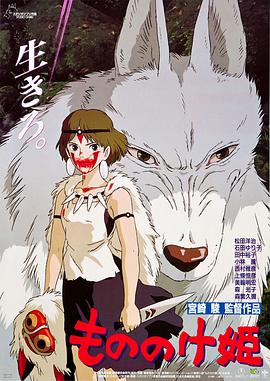
Anharten: One persistent theme across all of Studio Ghibli’s work, in particular Miyazaki’s, is that there rarely are any true villains. This sentiment is perhaps most apparent in Princess Mononoke, Miyazaki’s seventh film and notably one of his darkest. Set during the early 16th century, the film follows the story of Ashitaka, the last remaining prince of a small eastern village who is wounded while defending his home from a wild boar overtaken by a malicious spirit. Mortally cursed with no hope of a cure, Ashitaka takes it upon himself to journey to the West and discover and halt whatever malevolent force is causing this havoc. What he finds there is more complicated than he could have imagined: a settlement of humans mining the region to build a home while fending off the forces of the nearby forest who see their world being destroyed. Later he meets San, a young woman raised by the clan of wolves who defend the forest as he attempts to broker an uneasy peace between the two sides. Princess Mononoke is the epitome of Miyazaki’s appeal to environmentalism, melding traditional fantasy and Japanese folklore to create the director’s most serious and adult-oriented work to date. The film’s violence is a sharp divergence from Miyazaki’s relatively goreless body of work, with limbs being severed with callous abandon and wild boar gods weeping blood as they trudge on a death march through the forest. It’s an exhilarating, heartbreaking and colossal film whose message will leave audiences changed by its final scene. Quite simply, it is everything that one would come to expect from the pedigree of Hayao Miyazaki.—Toussaint Egan

Movie

The Raccoon War (1994)
平成狸合戦ぽんぽこ
★ 8.7 (449 ratings) director: 高畑勋 actor: 古今亭朝太時代 / 三木纪平 …
other title: 百变狸猫 / 平成狸合戦ぽんぽこ …
The Raccoons of the Tama Hills are being forced from their homes by the rapid development of houses and shopping malls. As it becomes harder to find food and shelter, they decide to band together and fight back. The Raccoons practice and perfect the ancient art of transformation until they are even able to appear as humans in hilarious circumstances.
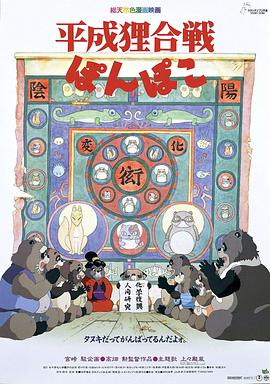
Anharten: Pom Poko is the type of film that feels inconvertible from its cultural origin. Forget trying to make this one more palatable for Western sensibilities, Pom Poko doubles down on the qualities that identify it as Japanese film and brandishes them proudly for all to see. Although better known for his realistic human dramas rendered through increasingly more experimental animation techniques, Pom Poko is Isao Takahata’s first foray into full-on fantasy farce, depicting the story of a clan of Japanese raccoon dogs (known as “tanuki”) whose home is ravaged by urban development. Emboldened both to defend their home and possibly learn to peacefully coexist alongside the humans, the tanuki retrain themselves in their lost ancestral ability of transformation to disguise themselves in modern society. But what distinguishes Pom Poko as such a unique cultural curiosity? The answer is simple: balls. Or, to be more descriptive, the on-screen prominence of the tanuki’s testicles as they use them in increasingly more inventive ways to disguise or defend themselves. Though surprisingly non-explicit and unquestionably coded as a children’s comedy film, this aspect might turn off potential audiences from exploring it and perhaps explains why the movie is relatively so unknown even among ardent of Studio Ghibli fans. Still, Pom Poko is a brilliant slapstick take on traditional Japanese mythology—something of a cross between Watership Down meets The Gods Must Be Crazy—that’s full of zany and inventive animation and genuine emotional depth. If you’ve always yearned in your heart of hearts for a Studio Ghibli film where a pack of anthropomorphic raccoons use their gigantic testicles as bludgeoning weapons in a last stand against police officers, rest assured because your prayers have been answered.—Toussaint Egan

Movie

Barefoot Gen (1983) WikiData IMDb TMDB Douban
はだしのゲン
★ 8.9 (11 ratings) director: 真崎守 actor: 宫崎一成 / 甲田将树 …
other title: 赤足小子 / はだしのゲン …
A story about the effect of the atomic bombing of Hiroshima on a boy's life and the lives of the Japanese people.
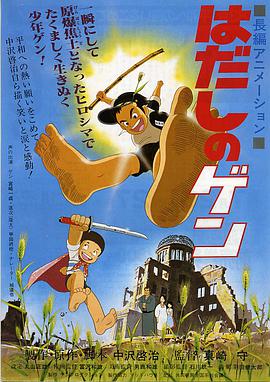
Anharten: There is perhaps no more catastrophically significant event in modern Japanese history than that of the nuclear bombardment of Hiroshima and Nagasaki during World War II. Keiji Nakazawa’s 1973 semi-autobiographical manga Barefoot Gen is a testament to this event, depicting one young boy’s struggle to survive in the wake of witnessing his friends and family gruesomely disintegrated by the indiscriminate force of a nuclear impact. Mori Masaki’s adaptation takes Nakazawa’s original and brings it to life on screen, delivering a harrowing snapshot of one of history’s most horrific instances of mass annihilation. The fateful scene where the Enola Gay detonates the bomb over Hiroshima is breathtaking and heart wrenching, as six-year old Gen’s home is pummeled in a shockwave of devastating power before subsiding into a plume of atomic hellfire. But to reduce Barefoot Gen’s significance to that of only being destruction porn created to induce guilt would be disingenuous. The film is, all in all, a human story of resilience and stubborn hope in the face of annihilation, and hopefully can be looked back upon as a sobering reminder of the costs of unremitting warfare and what we all still have to lose if we were to forget the lessons of the past.—Toussaint Egan

Movie

Metoroporisu (2001) WikiData IMDb TMDB Douban
メトロポリス
★ 7.7 (336 ratings) director: 林太郎 actor: 井元由香 / 小林希唯 …
other title: 大都会 / メトロポリス …
2001 anime film directed by Rintarō
Anharten: Not to be confused with Fritz Lang’s landmark 1927 sci-fi film of the same name, Metropolis is instead a loose adaptation inspired by Osamu Tezuka’s 1949 manga, which itself was inspired in part by Lang’s aforementioned opus. Written by Katsuhiro Otomo and directed by Rintaro, the film’s aesthetic and themes share more than a passing resemblance to Otomo’s genre-defining Akira. Set in the titular multi-layered megacity amid social upheaval between the human bourgeoisie and the robotic working class, Metropolis follows the story of private detective Shunsaku Ban and his nephew Kenichi who, while visiting Metropolis on their mission to apprehend the nefarious Dr. Laughton, happen upon a mysterious robotic girl named Tima whose existence may in fact hold the key to either the city’s salvation or destruction. Much like Akira, Metropolis is a sprawling epic of intersecting storylines, sweeping set pieces, and monolithic settings packed with a dense array of intricate details and beautiful color palettes. Decidedly darker than Tezuka’s manga, the film is neither an adaptation of either that or Lang’s film but rather an attempt to expand upon the inspiration of the two. A high-flying sci-fi adventure that doubles as social commentary for the shared struggle and seemingly inevitable antagonism between factions of the lower working class and humankind’s hubristic quest for power and control of a world that dwarfs their ambitions. Metropolis may not have struck big at the box office—only earning $4 million towards its $15 million budget—and it may not resonate with the same cult classic recognition as films like Ghost in the Shell or Ninja Scroll, but it remains an immense achievement by two of the greatest anime directors alive who sought to both honor and surpass the work of one of the most influential anime pioneers of all-time.—Toussaint Egan

Movie

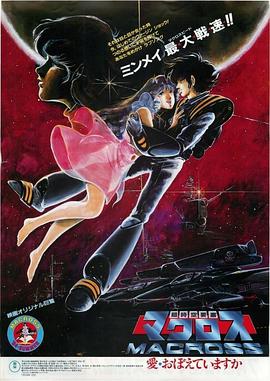
Super Dimension Fortress Macross: Do You Remember Love? (1984)
超時空要塞マクロス 愛・おぼえていますか
★ 8.8 (50 ratings) director: 石黑升 / 河森正治 actor: 长谷有洋 / 饭岛真理 …
other title: 超时空要塞:可曾记得爱 / 超時空要塞マクロス 愛・おぼえていますか …
It is A.D. 2009 and the human race is caught in a war between giant humanoids, male Zentrans and female Meltrans. Returning from the edge of our solar system after making a space fold, the SDF-1 Macross makes the long journey back to Earth with survivors of South Ataria Island.
Anharten: Shoji Kawamori’s Macross, known in the United States as Robotech, has a convoluted history both in its country of origin and here in the states. The first Macross movie, 1984’s Macross: Do You Remember Love? further complicated the Macross legacy. The film is essentially a reimagining of the (at the time) popular TV series, Macross. Like the show, the film centers around the crew of a giant space fortress, Macross, as they attempt to evade an alien race, the Zentradi, and discover that the key to their victory just might be the effect that Earth-made pop music has on their enemy. Yes, you read that right. The film’s other focus is the love triangle between dashing pilot Hikaru Ichijyo, pop idol Lynn Minmay, and lieutenant Misa Hayase. Although the cast of characters and voice actors are the same as those that appear in the TV series, and the plot covers much of the same ground, within the canon of the Macross universe, Do You Remember Love? is actually a popular, fictionalized retelling of the true events that occurred in the series. Regardless, Macross: Do You Remember Love? nails everything great about the show—gorgeous mecha designs, excellent dramatic (if a little over the top) storytelling, and an alternatively infuriating and captivating love triangle—and does so in a little over two hours. If you’re looking to understand the appeal of Macross, this is the place to start. In many ways it is typical of its time, in terms of character design, themes and the plot device of a band of humans on the run from an alien menace. Yet it is an incredibly well designed, directed and animated film that retains its sense of adventure even in the context of the somber overall plot. A massive hit in Japan, it has never had an uncut, official release in the United States due to legal squabbles between Harmony Gold, the American rights holder for Macross, and various Japanese production entities. The original film was a huge hit in Japan, with lines stretching around the block on the weekend of its premiere, and is now considered a classic. It’s hard to track down for U.S. fans, but well worth the effort for anyone looking for a good space opera … and pop music good enough to defeat an alien race. —J.D.

Movie

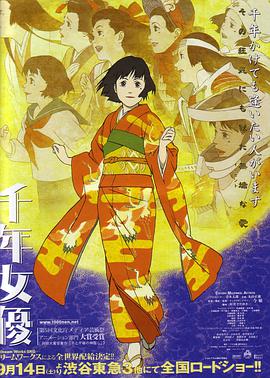
Millennium Actress (2001)
千年女優
★ 8.8 (1709 ratings) director: 今敏 actor: 庄司美代子 / 小山茉美 …
other title: 千年女优 / 千年女優 …
2001 Japanese anime film directed by Satoshi Kon
Anharten: Satoshi Kon’s second film, Millennium Actress, builds off the themes of cinema and celebrity previously explored in his debut Perfect Blue, instead casting them in the mold of a metafictional fairytale quest for love. Inspired by the lives of Setsuko Hara and Hideko Takamine, two of Japan’s premiere early-century stars, Millennium Actress follows the story of Chiyoko Fujiwara, a reclusive septuagenarian who recounts the story behind her illustrious career as a film actress when approached by a pair of interviewers eager to film a documentary. One of Kon’s signature motifs as a director is the mutability of reality and fantasy, exploring how the two constantly dovetai into one another, creating works that speak to the multiplicity of the human experience. Millennium Actress is a prime example of this, with the film’s presentation constantly assaulting the fourth wall, blending factual events and cinematic flair until the two are inseparable. Unlike most of his contemporaries, Kon was not satisfied to look only toward the insular vacuum of genre anime for inspiration, but instead looked to such works as George Roy Hill’s 1972 adaptation of Slaughterhouse-Five, a film whose use of scene cuts and transitions play a huge role in distinguishing Millennium Actress among other films of its time. Combining references to the physical comedy of Buster Keaton, Akira Kurosawa’s Throne of Blood and Hiroshi Inagaki’s Rickshaw Man, Millennium Actress is a testament to Kon’s enduring love of cinema. It deserves to be seen, examined and cherished for years to come.—Toussaint Egan

Movie

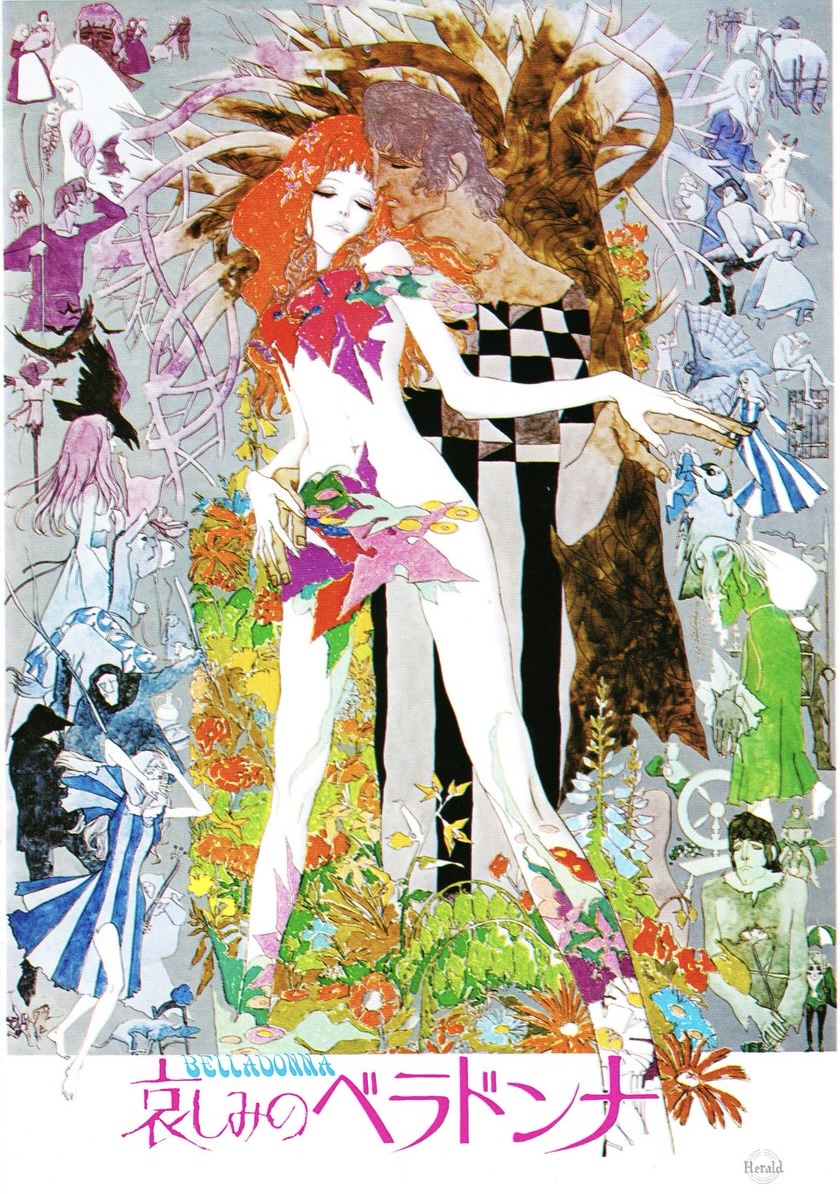
Belladonna of Sadness (1973)
哀しみのベラドンナ
★ 8.6 (214 ratings) director: 山本映一 actor: 长山蓝子 / 仲代达矢 …
other title: 悲伤的贝拉多娜 / 哀しみのベラドンナ …
1973 film by Eiichi Yamamoto
Anharten: Inspired by Jules Michelet’s book Satanism and Witchcraft, the third and final film in Osamu Tezuka’s “Animerama” trilogy was so expensive and avant-garde, its failure bankrupted its production company, Mushi Pro. The only film in the trilogy not directed by Tezuka (he left the project in its conceptual stages), Eiichi Yamamoto’s Belladonna of Sadness is amongst the most unusual animated films ever put to celluloid. This is not a huge surprise from a talent as legendary as Yamamoto, among whose mighty credits are titles like Kimba the White Lion and Space Battleship Yamato. Belladonna of Sadness is the tale of a village woman named Jeanne who is raped by her liege lord and his men on her wedding night, then makes a literal deal with the devil to gain magical powers and lead a rebellion against her rapists. Belladonna is extreme in every sense of the word: Start with the look—the film consists almost entirely of pans across still watercolor paintings, with occasional expressive bursts of color and movement scattered throughout. The designs owe virtually nothing to traditional anime character construction, or even Tezuka’s own, more cartoonish style. Instead, the film’s great debt is to European painters like Gustav Klimt, Degas and Kandinsky, among others. Filled with haunting music, lots of disembodied voice-over and vibrantly rendered yet horrifying scenes of rape, nudity, murder and madness, it’s no surprise Belladonna of Sadness was banned in many countries for decades. The feminist subtext of the film is very much foregrounded—clearly Jeanne is an avatar for Jeanne D’Arc (Joan of Arc), and there are also direct links in one scene between Jeanne and Marianne, the female personification of the French Republic—and despite the darkness Jeanne wallows in and the horrors she is subjected to, this is a film worth experiencing, mostly because there has really been nothing like it either before or since. The tale is brutal, but the beauty in which it’s told means we can’t look away. —Jason DeMarco

Movie

Redline (2010)
Redline
★ 8.2 (144 ratings) director: 小池健 actor: 木村拓哉 / 苍井优 …
other title: 红线 / 超时空甩尾(台) …
2009 film by Takeshi Koike
Anharten: Without question, Takeshi Koike is one of the greatest animators alive and working today. Problem is, you’ve probably never heard of him. Not surprising, considering his most critically recognized work was not produced until well into his late thirties. Recruited by studio Madhouse straight out of high school in 1986, Koike became something of a protégé to veteran director Yoshiaki Kawajiri and cut his teeth as an inbetween animator for such films as Cyber City Oedo 808 and Ninja Scroll before striking out on his own projects during the 2000s. After directing projects such as Trava: Fist Planet, The Animatrix short “World Record,” and the pilot for Afro Samurai, Koike poured the sum total of his talents into creating what is now popularly considered his opus: Redline, a stylistically bold high-octane racing adventure nearly seven years in the making. Koike’s style is unmistakable, with exaggerated silhouettes framed by jagged shadows, extreme focal points, and unrelenting action that recalls the works of Mike Mignola, Frank Miller and Peter Chung. Redline is a feast for the senses, a no-holds-barred visual spectacle with every framed packed with innocuous intricacies rendered in meticulous loving detail. The story is threadbare, no doubt, but as a film that triumphantly pays off its protracted gestation period with a product that’s this unabashedly impressive and downright cool, Redline squarely fits into the select number of anime films that one just has to see before they die.—Toussaint Egan
Reply Quote Sept. 25, 2026