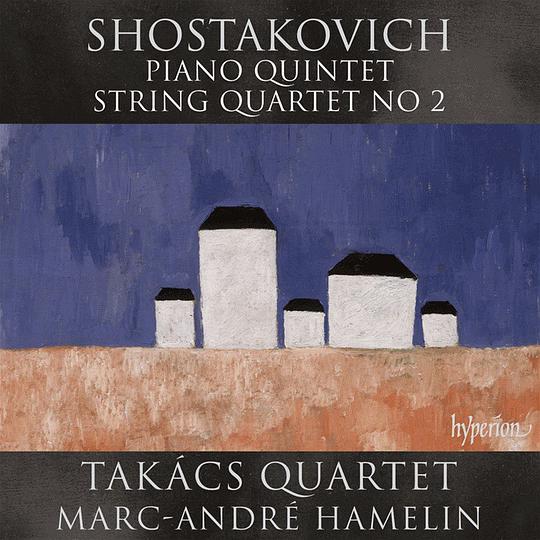
It is hard to envisage a more enticing prospect: Shostakovich’s densely woven String Quartet No 2 and his deceptively backward-looking Piano Quintet, performed by the stellar Takács Quartet and Marc-André Hamelin, generously notated by David Fanning, and lovingly recorded by Hyperion’s Simon Eadon and Andrew Keener team. Seventy minutes of post-Revolutionary Russian ecstasy.
Between the ages of ten and thirty, Shostakovich lived through the overthrow of the Tsarist autocracy, the Bolshevik coup, the early death of his father, the privations of Civil War, the painful compromises of Lenin’s New Economic Policy, the ascent to power of Joseph Stalin, a helter-skelter industrialization, the collectivization of agriculture, famine, show trials and the incipient Great Terror.
His professional CV meanwhile charted a rise from the ranks of teenage prodigy—both as pianist and as composer—to the status of the Soviet Union’s most prominent musical figure. In these years he made his mark in symphony, concerto, opera, ballet, theatre and film music, works for solo piano, and, to a lesser extent, songs.
Early in 1936, however, Shostakovich’s starry career lay seemingly in ruins, thanks to two vicious, anonymous articles in Pravda, the official organ of the Communist Party, castigating his music and demonstrating the Party’s determination to enforce loyalty and suppress individualism, in the arts as in society at large.
Amid this welter of intense personal and social experience it may come as no surprise that the one area of composition the young Shostakovich rather neglected was chamber music. Traditionally this was the kind of music most insulated from the concerns of the outside world and most likely instead to afford access to the innermost reaches of the soul. But that very tradition left chamber music open to the charge of bourgeois elitism—one more challenge faced by Soviet composers seeking to adapt it to the Bolshevik environment. Paradoxically, just as the 1930s saw the gathering clouds of Stalinist Socialist Realism, so a partial ‘re-bourgeoisification’ of Soviet culture was under way, and the previous more-or-less tacit disapproval of the string quartet began slowly—once again tacitly—to relax.
Shostakovich’s own first numbered quartet was composed in 1938, and its expressive world is one of happiness, simplicity and renewal—or rather, perhaps, a longing for all those things. At that time few could have prophesied that he would go on to produce a cycle of fifteen quartets that now rank alongside the six of Bartók as the most important of the twentieth century, or that these works would come to rival his symphonies in their dramatic and emotional range.
Shostakovich’s enduring commitment to the string quartet owed much to the devotion of Russia’s pre-eminent chamber ensemble at the time. On 16 January 1944 he attended the twentieth anniversary concert of the Beethoven Quartet in the Small Hall of the Moscow Conservatoire, and later that year he composed the String Quartet No 2 in A major, Op 68, with them in mind. It was premiered on 14 November, and on the same occasion the composer himself joined the first violinist and cellist for his Piano Trio No 2—another premiere. The creative relationship endured another thirty years, and the Beethovens premiered all but the last of Shostakovich’s subsequent quartets.
Despite its innocent-seeming movement titles, the second quartet is a far more ambitious work than its largely benign predecessor. Indeed, quite why Shostakovich should have given the opening movement the modest-seeming heading Overture is something of a mystery. This is in fact a fully worked-out sonata-form movement, complete with exposition repeat. The trenchant opening, with its heavily accented folk-dance character, establishes a tone of wiry contention. The texture is densely woven, the emotions pressure-cooked. At the beginning of the development section the tension relaxes briefly. But blink and you could miss that, because the music soon plunges back into the maelstrom.
The Recitative and Romance second movement poured from the composer’s imagination in a single day (the first movement had taken all of four days to write). What dramatic scenario, if any, may lie behind the violin’s passionate laments is undisclosed, though the ongoing tensions in Shostakovich’s private and public life could have supplied rich material. Perhaps they are an attempt to emulate the profound yet untranslatable eloquence of late Beethoven. Perhaps the thinly veiled Jewish intonations convey a message of personal or social solidarity. Or perhaps the Recitative is a heartfelt tribute to the communicative flair of the Beethoven Quartet’s leader, Dmitri Tsïganov, who certainly claimed that the movement was composed with his playing in mind. At any rate the first violin also leads off the central Romance, which is another emotionally unstable affair. Essentially this is an accompanied free variation of the Recitative material, which eventually drags the other instruments into the foreground.
Every one of Shostakovich’s quartets has at least one muted movement, redolent sometimes of consoling but out-of-reach experiences, at other times, as here in the Waltz third movement, of anxiety and frustration. The shadowy opening is a waltz faster than any that could be danced. Ever more intense fortissimos run up against the constraints of the ensemble’s muted sonority, provoking a state of near-paranoia (this is also a feature of the finale of the second piano trio, incidentally).
The third movement’s key of E flat minor is about as distant from the quartet’s overall tonic of A major as can be imagined. So the finale begins by trying to bridge the gap. It only succeeds in achieving A minor, however, and even at the end there is no consoling reinstatement of the tonic major. The Theme is first heard on the viola and marked semplice. But simplicity in Shostakovich is almost always a remembered or longed-for state of being, hardly ever actualized. As the Variations accelerate towards Allegro, they seem destined to lead us into a recall of first-movement material. Yet this is one of the few Shostakovich quartets not intricately bound together by cyclic reminiscences. Nor does the music quite tip over—though it threatens to—into the circus-like antics of his near-contemporary ninth symphony. Instead the movement is driven onwards by unspecified demons, and in the end the message seems to be that the best that can be hoped for is to out-stare them. Thanks to Shostakovich’s unerring control, this makes for as inspiring a conclusion as anything more straightforwardly victorious.
With the exception of Prokofiev, who regarded it as disappointingly middle-of-the-road for its day, commentators have generally looked with favour on Shostakovich’s Piano Quintet in G minor, Op 57. That includes the Soviet cultural watchdogs, who were moved to award it a Stalin prize, first class, perhaps in recognition of the fact that it stood head and shoulders above any other chamber music that had been composed in Russia since the 1917 Revolution. In fact, so popular has the piece become with performers and audiences that it has joined the piano quintets by Schumann, Brahms, Dvořák, Franck and Elgar in the select ranks of core repertoire for this ensemble.
According to the literary historian Isaak Glikman—Shostakovich’s one-time secretary and his friend and correspondent for over forty years—the piano quintet began life as a string quartet (the composer’s second). The first quartet had appeared in 1938, and Shostakovich had been so delighted with its performances by the Beethoven Quartet that he decided that rather than continue with another quartet he would first produce something he could perform with them in concert. From the quintet’s premiere in September 1940 to a performance of its fourth movement alone in 1964 (by which time he was rapidly losing the effective use of his right hand) Shostakovich did indeed perform the work many times, and he made recordings of it both with the Beethovens and with the Borodin Quartet.
The piano quintet followed on closely from the sixth symphony of 1939. Although it is less elaborate and wide-ranging in character than that manic-depressive masterpiece, it offers much scope for varied interpretation—by performers and commentators alike. It also shares a crucial preoccupation with the style of J S Bach. Not only are the first two movements a Prelude and Fugue, with copious reference to Bachian models, but the fourth movement is fashioned as a neo-Baroque aria over a ‘walking’ bass. Shostakovich turned to Bachian counterpoint for compositional renewal at various times in his life, and in this he was no different from many of his composer-colleagues in the West. But given the pressures under which he had to operate in the Soviet Union from the mid-1930s on, this return to pure wellsprings carries extra significance: this is not so much ‘back-to-Bach’ for stylistic fun and games, as ‘inwards-to-Bach’ for wisdom and artistic self-preservation.
The two movements of the piano quintet most distant from Baroque models are the rough-and-tumble Scherzo and the deceptively innocent Finale. Both of these were frequently encored in early performances, leading to the remark that this was a quintet in ‘five movements, of which there are seven’. How genuine or deceptive is the Finale’s innocence? That depends partly on how tragic we feel the previous Intermezzo to be, on how much of a shadow we feel that movement casts over the Finale, and on the way individual performances choose to shade the succession of moods.
David Fanning © 2015